Linh Nguyen builds spreadsheets in her head while she's still talking to the client. It's a habit from the early days of her company, when she was the only person selling, and every call had to end with a number she could trust by the time she hung up. Her office sits two floors above a phở stall on a side street off Nguyễn Huệ, close enough that the smell of star anise drifts up through the stairwell most mornings. She still remembers exactly which quarter the smell stopped being pleasant and started being the smell of "I haven't eaten since that call at 9."
For three years, Linh was her company's only closer. Not because she couldn't hire — she could, eventually — but because founder-led sales was the fastest way to learn what her market actually wanted, deal by deal, objection by objection. What nearly broke her wasn't the selling. It was everything wrapped around it: logging every call into a CRM built for a bigger company, updating a pipeline spreadsheet at midnight because the day had no other slot for it, chasing her own follow-ups because there was no one else to draft them.
"I didn't lose deals because I was bad at selling. I lost them because I was still updating a spreadsheet about yesterday's call when I should have been on today's."— Linh Nguyen, Founder

The Tax Nobody Puts on a P&L
Call it what it is: a tax. Not a line item anyone budgets for, but a real cost, paid in the only currency a founder-led sales motion actually has — hours where Linh could have been talking to the next customer instead of documenting the last one. And like most taxes nobody designs on purpose, it landed hardest on exactly the wrong person. Linh wasn't her company's weakest performer. She was carrying the most pipeline of anyone on the team, which meant she had the most admin, which meant the tax bill was biggest for the person who could least afford to pay it in time.
This is the part most sales admin conversations miss: busywork isn't a flat cost spread evenly across a team. It's regressive. A rep who closes twice as much pipeline generates roughly twice as many deals to log, twice as many follow-ups to chase, twice as many forecast lines to defend. The better you are at selling, the more the CRM makes you pay for it.
Linh started keeping an informal tally, mostly out of frustration, during her company's second year: how many minutes, after each client call, did it take to leave the pipeline in a state she'd trust the next morning? The answer settled somewhere around fifteen to twenty minutes per meaningful conversation — updating the deal record, drafting the follow-up email, noting the next step so she wouldn't have to reconstruct it from memory a week later. On a day with six client calls, that was two hours gone before she'd done a single hour of actual selling work like research, proposal-building or pricing strategy. The tax wasn't abstract. It had a number, and the number was bigger than she wanted to admit.
What Changed When the Admin Disappeared
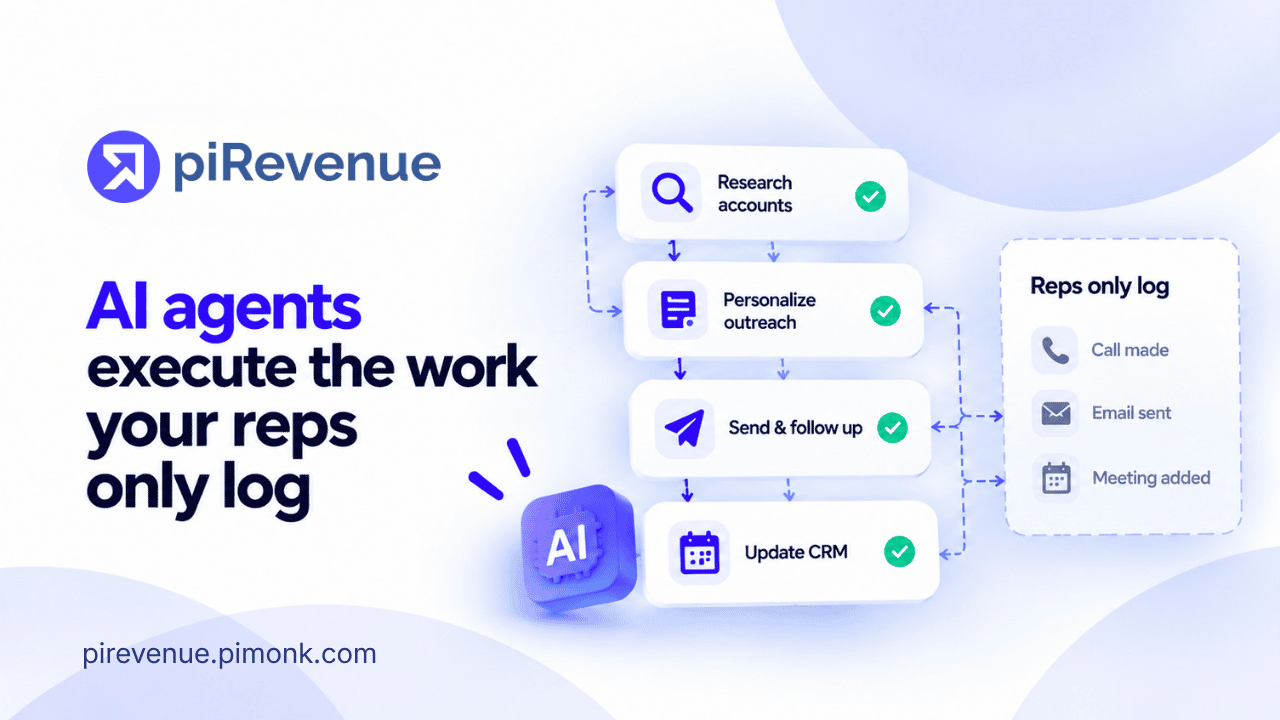
Linh didn't hire an assistant or adopt a stricter process. She moved her pipeline onto piRevenue and let deal capture happen from the calls and message threads she was already having — no separate step where she stopped selling to go describe the selling. Follow-ups that used to live in her head at 11 p.m. started arriving as drafts she could approve with one tap between meetings, instead of paragraphs she had to compose from scratch after the moment had gone cold.
The forecast stopped being a file she rebuilt at midnight and became a number that was simply already right when she opened her laptop in the morning. None of this closed a single deal for her. It didn't need to. It just stopped stealing the hours she needed to close the deals herself.
Regressive, Not Progressive
There's a version of this argument that says busywork is a "small tax, everyone pays it, no big deal." Linh doesn't buy that framing, and neither should you. A regressive tax is one that costs the people who can least afford it the most — and in a sales org, that's rarely the underperformer with three deals in their pipeline. It's the founder with forty. It's the top rep carrying the region. The people busywork costs the most are exactly the people whose time is worth the most to the business.
Think about what that does to incentives over time, left unaddressed. A rep who wants to avoid drowning in admin has a rational reason to avoid taking on more pipeline than they can comfortably log by hand — which means the tax doesn't just cost hours, it caps ambition. Linh watched this happen to one of her early hires, a strong closer who quietly started passing warm leads to a teammate rather than add them to an already overloaded personal queue. Nobody would have called that underperformance in a review. It was a rational response to a tax nobody had named.
Fix that, and the math changes everywhere at once. Linh's company didn't get a better spreadsheet. It got its highest-leverage hours back, for the person whose hours mattered most — and it got a team willing to take on more pipeline again, because taking on more no longer meant a proportional increase in unpaid clerical work at midnight.
Built for Founders Who Still Sell
Linh still closes every deal herself. That hasn't changed and, by her own choice, won't — founder-led sales is how she keeps her read on the market sharp. What changed is what "closing every deal herself" costs her now. Not midnight spreadsheets. Not a stairwell that smells like a missed lunch. Just the calls, the follow-ups that matter, and a number she can trust without rebuilding it by hand.
She's since hired two more reps, something she'd delayed for a year longer than she should have, mostly because she couldn't picture handing over a process that lived entirely in her own head and her own late nights. That's no longer the blocker it was. What used to be tribal knowledge — which deals needed a nudge, which client was about to go quiet, what the honest forecast actually looked like — now lives in a system both new hires can see on day one. The tax that once fell entirely on Linh is something her whole team shares the relief from now, not just her.
Stop feeding your CRM. Let the agents do the busywork.