Chidi Okonkwo has sold industrial supplies across Lagos for nine years, and in that time he has never once closed a deal by filling out a form. He's closed deals on the phone standing in traffic on the Third Mainland Bridge. He's closed them with a voice note recorded in a stairwell between meetings, talking fast because the client was already walking toward his car. He's closed them over a plate of jollof rice at a supplier's office in Apapa, where the actual negotiation happened somewhere between the second and third helping, long after the "official" meeting had ended. Not one of those moments looked anything like the tidy little text box a CRM asks you to summarize them into afterward.
This is not a Lagos problem, particular as the city's rhythm is. It's the plain, obvious problem with almost every CRM ever built for a field sales team: it assumes selling happens in the software. It doesn't. Selling happens in a call, a market-floor conversation, a WhatsApp thread with a client who's been ordering from you for six years and isn't about to start filling out your intake form. The software shows up afterward, asking the rep to translate a living conversation into a dead record — and that translation tax is where deals actually go missing.
"Nobody in Lagos does business by opening a form first. You talk, you agree, you shake hands — sometimes literally, sometimes over the phone. The deal already happened. The CRM just wants proof it happened, days later, from memory."— Chidi Okonkwo, Field Sales Lead

The Bridge, the Market, the Voice Note
Chidi runs a territory that stretches from Ikeja to the Lekki corridor, and on a normal day he might be in a client's warehouse by 8, on the phone with a distributor by 9:30, and standing in a market conversation by noon that has nothing scheduled about it — a supplier introduces him to a buyer he didn't know he needed, and the deal starts right there, unplanned, unscripted, and moving fast. There is no natural pause in that day long enough to sit down and type a clean CRM entry. By the time he gets one, the details have already started to blur — which client asked for the 90-day terms and which one wanted the smaller pallet size, whose number he was supposed to call back first.
What Lagos taught Chidi, and what Lagos should teach any CRM vendor paying attention, is that the conversation itself is the source of truth. Not a summary of the conversation, written under pressure two hours later by someone trying to remember details while already thinking about the next call. The actual thing — the call, the voice note, the forwarded thread — already contains everything a clean deal record needs. The only question is whether the system is built to read it, or built to make the rep retype it.
What "Roadmap" Actually Means Here
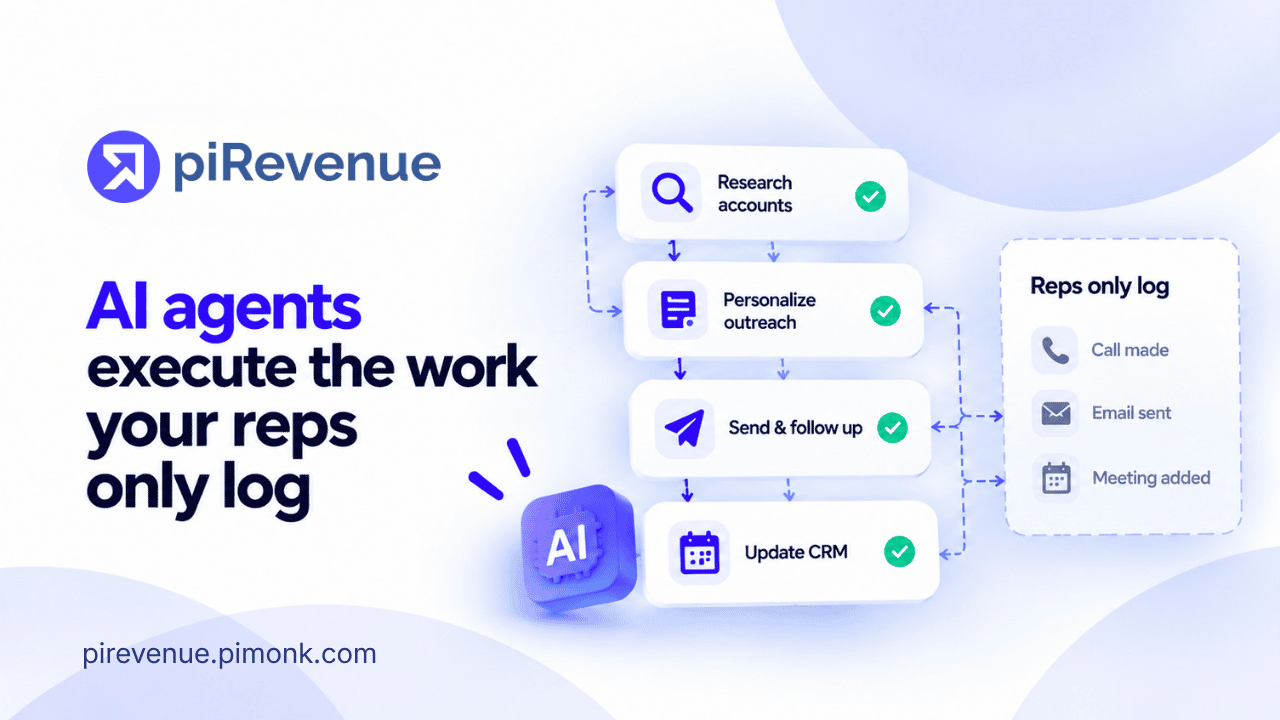
To be direct about it: piRevenue does not act inside WhatsApp today, and anyone telling you a tool "does WhatsApp" without a lot of specifics is worth a second, harder look. Messaging-channel integrations — the kind that would let an agent watch a conversation thread the way it already watches a captured call — are on piRevenue's public roadmap, not shipped. What is live today is the piece that mattered most in Chidi's actual week: capturing the conversation content reps already generate — a voice note after a client meeting, a call, a forwarded summary — and turning it into a structured deal without asking the rep to stop and type it twice.
That distinction matters, and it's worth being blunt about it rather than letting the roadmap items blur into the feature list. A rep in Lagos doesn't need software that pretends to be inside every channel they touch. They need software that stops treating the conversation as a formality to be documented later, and starts treating it as the primary record it already is.
The Deal Chidi Almost Lost to a Form
Chidi still tells the story of a distributor deal he nearly lost — not to a competitor, but to his own CRM. He'd closed verbal agreement on pricing and volume with a long-time client over a fifteen-minute call, the kind of call where both sides already know how this ends before it ends. He got back to his desk that evening, opened the CRM to log it, and found four required fields he didn't have answers to off the top of his head — a lead source classification, an internal account code, a forecast category. By the time he chased down the answers two days later, the client had already placed a smaller order with someone who called back faster. The deal wasn't lost to price or relationship. It was lost to the four minutes it took to satisfy a form that had nothing to do with the actual sale.
That's the story Chidi tells new hires now, not as a cautionary tale about diligence, but as an argument for building the record from what already happened instead of demanding it be reconstructed afterward. The conversation was the deal. The form was just friction standing between the conversation and the next one.
Selling Doesn't Need to Slow Down to Be Tracked
Nothing about Chidi's pace has changed since piRevenue started capturing his conversations automatically — and that's the point. He still moves the same way through Lagos: fast, relationship-first, comfortable with the fact that a good deal rarely follows a script. What's different is that the record now keeps up with him instead of asking him to slow down and build it by hand. The next step, the follow-up commitment, the number he promised a client — all of it lands in the deal record from the conversation itself, so nothing depends on Chidi's memory holding up at 9 p.m. after a fourteen-hour day.
He'll be the first to tell you the technology isn't the interesting part. What's interesting is what it frees him up to do: keep having the conversations, without the tax of translating every one of them into a form. "I didn't get into sales to become a typist," he says. "I got into it because I'm good at talking to people and figuring out what they actually need. Give me that back, and I'll out-sell anyone stuck filling in dropdowns."
Stop feeding your CRM. Let the agents do the busywork.