I was in a conference hall in Victoria Island, third row from the stage, when a vendor demoed an AI agent "closing" a deal live. The agent had drafted the proposal, negotiated the discount over email with a simulated buyer, and sent the contract — all without a human touching a key. The room applauded. I did not. I sat there thinking about every deal I've ever actually closed, and how none of them were a straight line from proposal to signature. They were arguments, hesitations, a client asking me — me, specifically, the person she'd built trust with over four months — whether this was really the right time to buy. An agent can draft a lot of things. It cannot have been in that room with her.
That afternoon is the reason piRevenue exists in the shape it does. Not "AI-powered sales," which is now a phrase so overused it means nothing. A specific, deliberate, occasionally commercially inconvenient line: agents do the busywork. Humans do the deal. We built the product to make that line impossible to cross by accident.

The pitch the industry keeps selling
Full autonomy is a seductive pitch, and I understand why. "Let the AI handle the whole funnel" sounds like leverage — infinite reps, working around the clock, closing while you sleep. I've sat through a dozen of those demos now. What none of them show you is the moment an autonomous agent, negotiating a discount with a buyer who's testing how far it will go, concedes eleven points it shouldn't have, because it optimized for "close the deal" instead of "protect the relationship and the margin." A human closer would have paused. Picked up the phone. Read the silence on the other end. An agent reads intent from text and nothing else, and in the moments that decide a deal, that is not enough.
"We didn't want AI that pretends to be a salesperson. We wanted our salespeople to stop being data-entry clerks. That's the whole thing."— Aisha Bello, VP Sales
What actually breaks when the agent closes
It isn't hypothetical. Every sales leader I've spoken with in this market has a version of the story: an automated sequence that kept "following up" after a client had verbally said no, souring a relationship that took a year to rebuild. A chatbot that quoted a price the sales team could never honor, because the buyer asked it a question at 11 p.m. and it answered with confidence instead of judgment. None of these tools were malicious. They were doing exactly what they were built to do — maximize a narrow objective, without the context, the restraint, or the accountability a human closer carries into every conversation.
The deeper problem is trust, not accuracy. A buyer who finds out — and they always find out — that the "relationship manager" emailing them is an unsupervised agent doesn't just lose trust in that email. They lose trust in the whole vendor. In markets like ours, where deals are won on relationship and referral as much as on product, that is not a cost you recover from with a better prompt.
What agents are actually good at
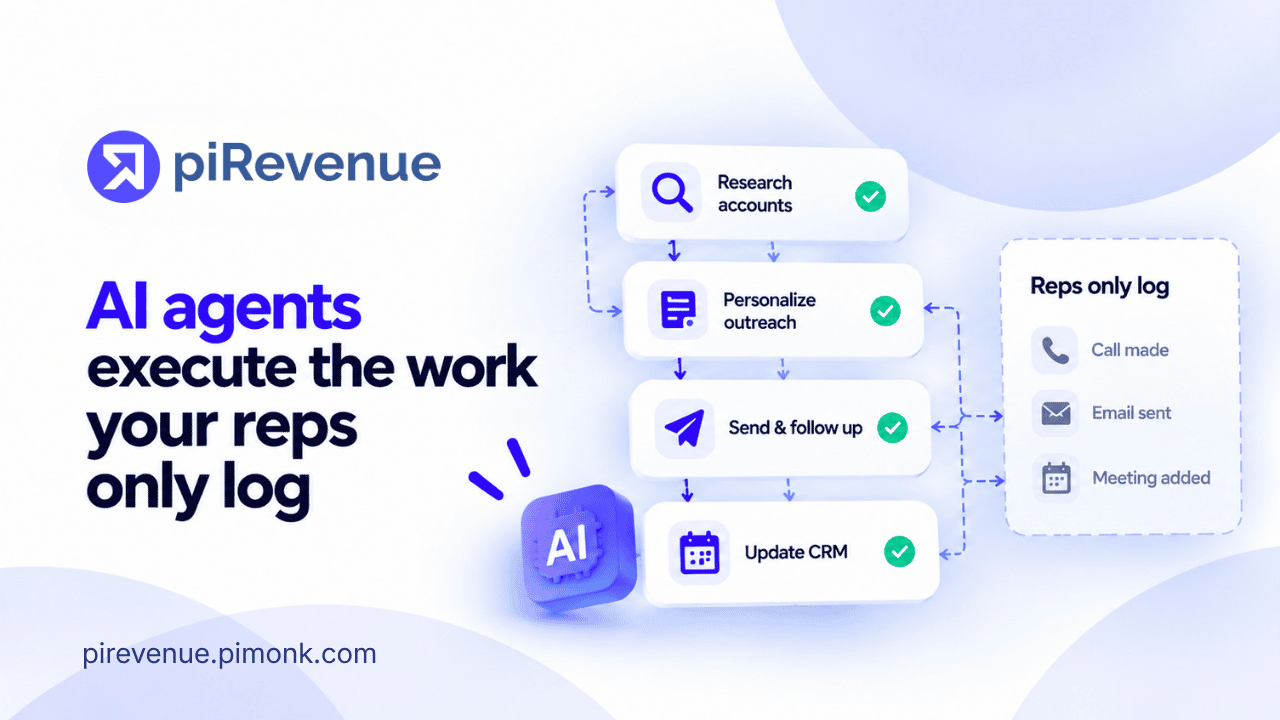
None of this makes agents useless — it makes them correctly scoped. The 72% of the sales week that isn't selling — logging calls, chasing quiet deals, updating a forecast, chasing a signature that's three days overdue — is exactly the work that benefits from a tireless, context-aware assistant that never forgets to follow up and never gets tired at 11 p.m. That is where piRevenue's agents live: drafting the nudge a rep approves with one tap, flagging the deal that's gone quiet, keeping a forecast current so nobody has to reconstruct it from memory on a Friday night. The agent does the noticing. The human does the deciding.
An audit trail, not a black box
Every approved action carries a record of who approved it and when. This isn't a compliance afterthought — it's the mechanism that makes the whole promise credible. If a customer ever asks "did a person actually see this before it was sent to me," the honest answer, provable in the system, has to be yes. That's a harder product to build than a fully autonomous agent. It is also the only version of this product I would put my name behind.
The uncomfortable trade-off we accept
I won't pretend this design choice is free. A fully autonomous agent can, in theory, work more hours than any human closer, respond faster than any inbox notification, and never ask for a day off. Every investor deck in this category leads with that speed. We accept a slower top-end on outbound velocity in exchange for something I think matters more in the markets we serve: a customer who never has to wonder whether the person on the other end of the deal is real. In a market where trust is built over years and destroyed in a single bad interaction, that trade-off isn't close.
It also means our reps stay accountable in a way a fully automated pipeline never has to be. When a deal is approved by a person, that person's name is attached to the decision — the discount, the promise, the timeline. That accountability is uncomfortable sometimes. It's also exactly what a buyer is trusting when they sign.
What we tell customers who ask
Prospects ask us directly, more often than you'd expect: "Is this just going to be a bot emailing me?" The answer, every time, is the same. An agent may draft what you receive. A named person on the account team reads it, edits it if it needs editing, and sends it. If you ever want to know whether a human saw a specific message before it reached you, we can show you — the approval is logged, timestamped, attributable. That's not a marketing claim. It's a product decision that shows up in the audit trail on every account, and it's the reason I'm comfortable putting my own name on this manifesto instead of a generic "the piRevenue team" byline.
The line, restated
AI should never close your deal, not because it isn't capable of drafting a plausible-sounding email, but because closing was never really about the email. It's about trust built over a phone call, a hesitation you noticed, a discount you chose not to give because you knew the relationship could hold without it. That judgment is human. We're not trying to automate it. We're trying to clear everything else off your desk so you have the hours left to use it.
Stop feeding your CRM. Let the agents do the busywork.