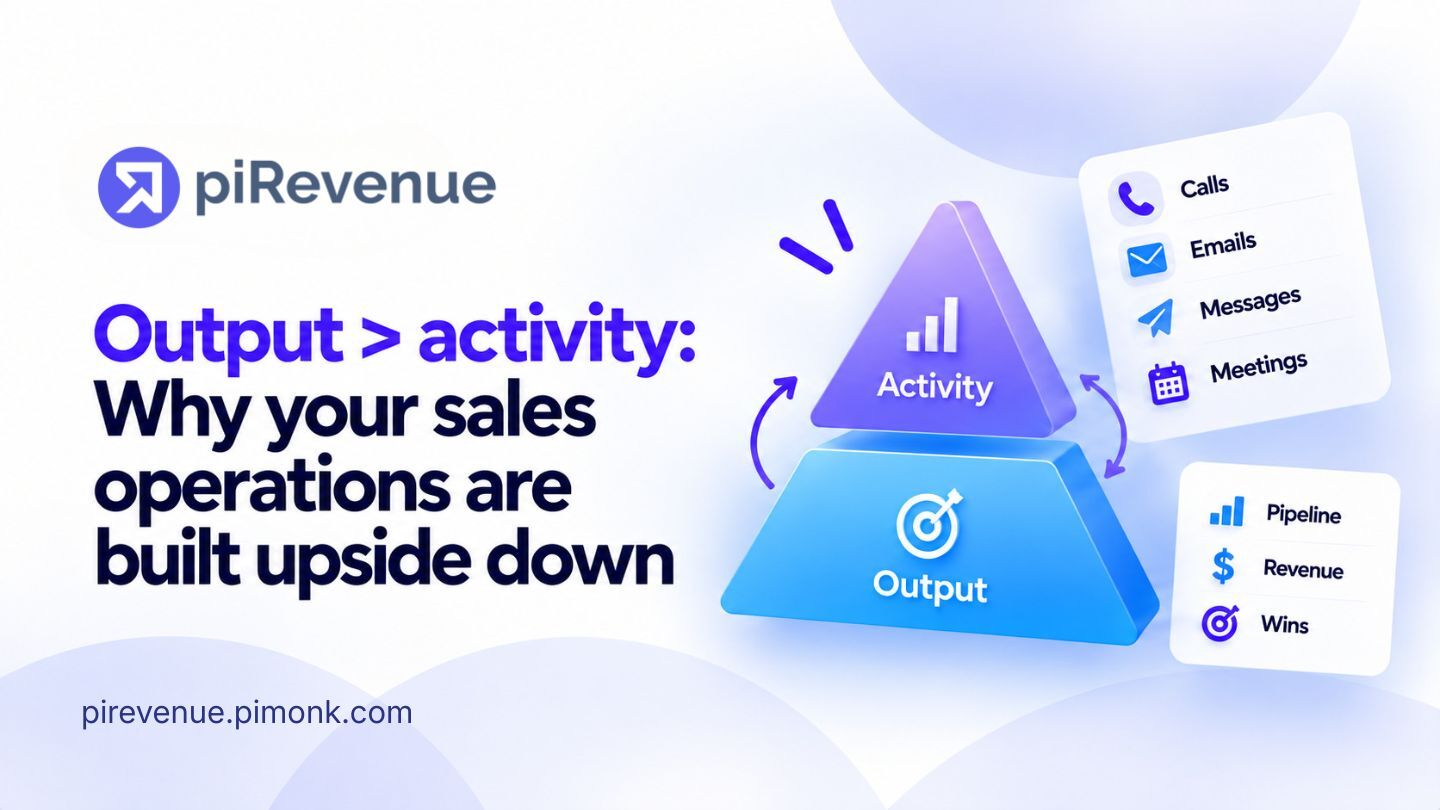
Look at how a sales organisation is built, and the shape is obvious. At the bottom, the foundation, sit activity metrics: calls, emails, meetings, demos. Everything rests on them. Compensation plans reward them. Dashboards track them. Managers coach to them. Hiring screens for people who can sustain them. And at the top, almost as an afterthought, sits the thing the company actually wants: closed revenue, retained customers, growing accounts. Output is treated as what happens if activity is sufficient. It is not the base of the system. It is the hope at the end of it.
This post is for the sales heads, CFOs and CEOs who inherited that structure and have not yet asked why it is the way it is. It looks at what "upside down" means in practice, why sales operations ended up measuring inputs, what changes when output becomes the foundation, which parts of sales ops need rebuilding first, and what finance should expect during the flip.
What does "built upside down" actually look like in a sales org?
It looks like a company that knows exactly how many calls were made last week and has to wait until the end of the quarter to find out whether any of it mattered.
The compensation plan has an activity component. Reps earn a portion of variable pay for hitting call, meeting or pipeline-creation targets, regardless of whether those turn into revenue. The intent was to reward effort. The effect is to make effort the job.
The weekly dashboard leads with activity. Dials, connects, emails, demos booked. Revenue is on the second tab. Managers open the first tab because that is where the daily conversation lives.
Coaching is activity coaching. A rep behind on revenue is told to increase outreach. The assumption is that more input produces more output. Nobody checks whether the input was pointed at the right accounts.
Hiring screens for stamina. Interview questions probe whether a candidate can make eighty calls a day. Whether they can run a discovery conversation that changes a buyer's mind is harder to test, so it is tested less.
Tooling is built to generate and count activity. Dialers, sequencers, engagement platforms. Each one increases volume. None of them can tell whether the volume was worth generating.
Every layer of the system is oriented toward inputs. Output is the result the system produces, not the thing it is designed around. That is upside down.
Why did sales operations end up measuring inputs?
Because for most of the history of sales management, inputs were the only thing that could be seen in time to act.
Revenue arrives at the end of a cycle. In enterprise sales, that cycle is months. A manager who only looked at revenue would be looking at decisions made two quarters ago. Activity was visible daily. It could be counted, compared and corrected. So managers managed what they could see.
This was reasonable. It was also a compromise. Activity was never the goal. It was the best available proxy for progress toward the goal, in a world where progress itself was invisible.
That world has ended. Buyer engagement is now visible. Email replies, meeting attendance, content consumption, stakeholder involvement- all captured from the systems where selling happens. Deal health can be measured continuously from what the buyer does, not from what the rep did. The proxy is no longer necessary. But the sales operations function was built around the proxy, and functions do not rebuild themselves when their reason for existing changes.
Sales ops today is still counting the thing it counted when it could not count anything else.
What changes when output is the foundation?
Compensation starts with revenue and works backwards. Reps are paid on what closed and what was retained. Activity targets disappear from the plan, because a rep who closes without high activity has done something right, not something wrong. The plan stops paying for effort and starts paying for results, which is what the company thought it was doing all along.
Dashboards lead with deal health and revenue trajectory. The first screen shows which deals are progressing based on buyer behaviour, which are stalling, and what the quarter looks like if nothing changes. Activity is available as a diagnostic, one level down, for when a manager wants to understand why a rep's output is low.
Coaching starts from outcomes. A rep with low output is examined for cause. Wrong accounts, weak discovery, poor follow-up, bad territory. The remedy depends on the cause. "Make more calls" is one possible remedy among several, and rarely the right one.
Hiring tests for the ability to move a buyer. Case exercises, mock discovery, evidence of past deals that were genuinely won rather than inherited. Stamina still matters, but it is the second question.
Tooling is judged on conversion, not on volume. A sequencing tool that doubles email volume and leaves reply rates flat has made things worse. A research tool that halves outreach and doubles meetings has made things better. Sales ops evaluates tools on what they do to output, and cuts the ones that only increase input.
The organisation gets quieter and more focused. Fewer calls. More conversations that matter. Reps who feel trusted rather than monitored. Managers who understand their pipelines rather than their activity reports.
Which parts of sales ops need rebuilding first?
Not everything at once. The order matters, because each step makes the next one possible.
-
The compensation plan: This goes first because it drives everything else. Remove activity components. Pay on closed revenue, net retention and, where cycles are long, on verified stage progression based on buyer actions. Reps will change behaviour within one pay period.
-
The primary dashboard: Rebuild it around deal health signals captured from buyer behaviour. This requires connecting email, calendar, and call data to the CRM through an agent layer that reads and structures it. Activity metrics move to a secondary view.
-
The pipeline review: Change the agenda from status updates to decisions on flagged deals. Shorten it. Make it about what to do, not what happened.
-
The coaching model: Train managers to diagnose low output rather than prescribe high activity. Give them call recordings and deal timelines, not dial counts.
-
The hiring rubric: Rewrite interview scorecards around evidence of moving buyers. Add a practical exercise. Reduce the weight on activity history from previous roles.
-
The tool stack: Audit every sales tool against a single question: does it improve conversion or just increase volume? Cut the ones that only do the second.
Each of these is a project. Together they take a year. But the compensation change alone, done in a quarter, produces most of the early benefit, because it changes what reps optimise for before anything else has moved.
What should the CFO expect during the flip?
The discomfort comes first. Activity metrics will drop, because reps stop doing work that was only done to hit a number. Some managers will read this as a collapse in effort and escalate. The CFO should expect this and should not react to it. The relevant question is what happens to conversion and revenue, and those take a cycle to show.
Pipeline will shrink. Deals that existed to satisfy coverage ratios will be removed once coverage is no longer rewarded. The pipeline that remains is smaller and real. The forecast built on it will be lower than before and far more accurate. Finance should re-baseline rather than treat the drop as a warning.
Some reps will leave. The ones whose value was sustaining activity will find the new plan harder. Some of them were closing on volume alone, and the company will miss them. Most were not. Attrition in the first two quarters is normal and mostly healthy.
Tooling spend should fall. A stack built to generate volume has several tools whose only output is more activity. Cutting them funds the agent layer that captures buyer behaviour, which is where the new dashboard comes from.
After two to three quarters, the picture stabilises. Fewer reps, less activity, cleaner pipeline, higher conversion, a forecast that finance can build a plan around. That last item is the one the CFO should hold the sales leader to. It is the actual return on the flip.
Conclusion
Activity-based sales operations were built for a world where output was invisible until it was too late to change. That world is gone. Buyer behaviour is now visible in real time, and the proxy that stood in for it has become a distraction from it.
But the flip is not really a change in metrics. It is a change in where power sits. An activity-based system gives managers control over reps by controlling their day. An output-based system gives reps control over their day and holds them to results. Sales ops moves from policing inputs to designing the system that makes outputs visible and predictable. That is a bigger job and a more useful one. Some sales ops teams will welcome it. Others will discover that their function was built to count, and counting is no longer needed.
There is one trap on the other side. Output measured too narrowly becomes its own distortion. A rep paid only on this quarter's closes will discount, over-promise and ignore accounts that pay off next year. The question is never just "output over activity." It is "which output, over what horizon." A company that answers that clearly has built its sales operation the right way up. A company that just swaps dial counts for close counts has turned the same mistake over and called it a fix.