The best sales heads have stopped counting calls. Not because calls do not matter. Because counting them was always a substitute for knowing what was happening in the pipeline, and that substitute is no longer needed. In its place, these sales heads are running an agentic engine: a set of AI agents that capture every deal, chase every quiet one, keep the forecast live, and hand the decisions to humans. The dashboards look different. The weekly meetings look different. The job of the sales head looks different.
This post is for the sales heads, CFOs and CEOs who are watching this shift and deciding whether to make it. It covers why activity metrics are being abandoned now, what an agentic engine is in plain terms, what sales heads measure once activity is gone, how the pipeline review changes, and what separates the leaders who make the switch from those who do not.
Why are top sales heads abandoning activity metrics now?Activity metrics existed to give managers something to see. Revenue arrives at the end of a cycle. In between, a manager could not tell whether a rep was making progress or spinning. So the manager counted calls, emails and meetings, and treated the count as progress. Everyone understood it was a proxy. Over time, the proxy became the target, and reps learned to produce the number rather than the outcome.
Three things ended this. Buyer behaviour became visible: replies, meeting attendance, stakeholder involvement, all captured from the systems where selling happens. AI agents became capable of reading that behaviour and acting on it. And the cost of activity dropped to nearly zero, because agents can generate unlimited outreach. When activity is free, a count of activity is worth nothing.
The sales heads who saw this first were the ones who had been burned by it. A team that hit every activity target and missed the quarter. A forecast built on rep-entered stages that collapsed in the last week. A top performer who left because the job had become data entry. Each of these is a reason to stop counting. Together they are a reason to rebuild.
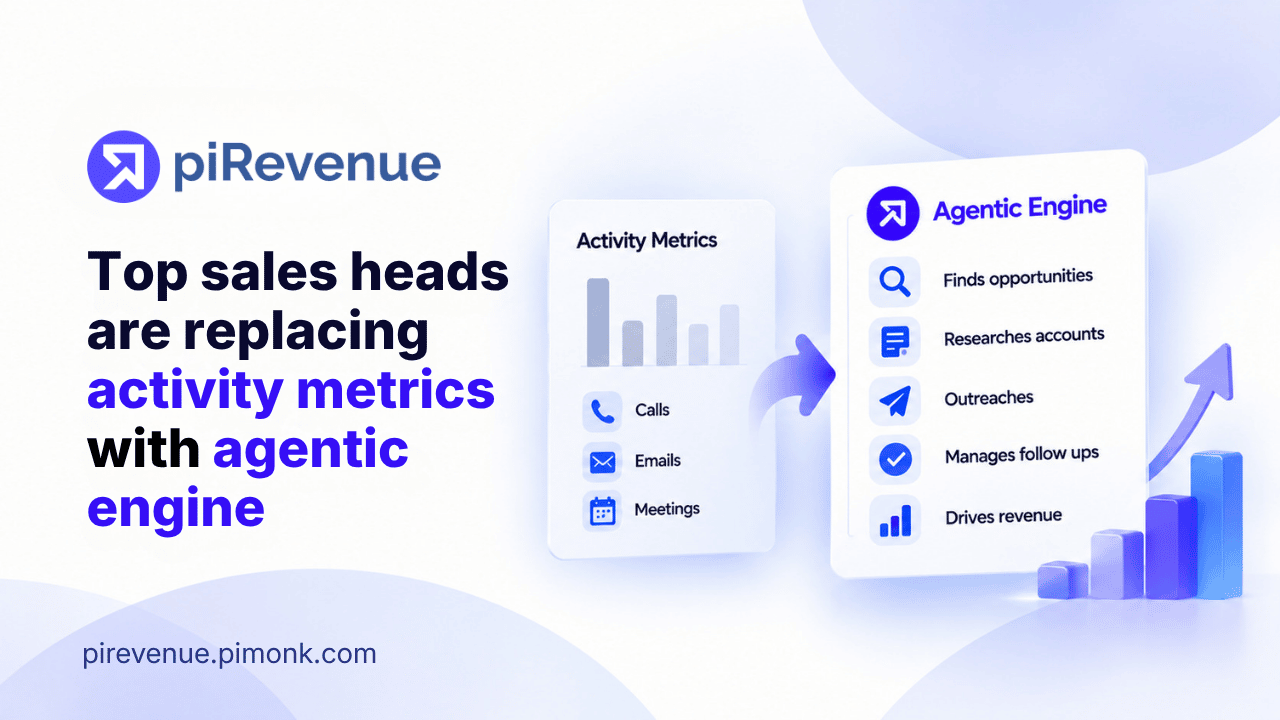
What is an agentic engine, in plain terms?A set of specialist agents that do the work around a deal and hand the decisions to a person.
One agent captures. It reads a voice note, a forwarded email or a message and turns it into a structured deal record: contact, value, stage, next step. The rep does not type anything.
One agent watches. It tracks every open deal for buyer activity. When a deal goes quiet, it flags the risk before the rep would have noticed.
One agent chases. It drafts the follow-up in the rep's voice, proposes the next step, and puts it in front of the rep to approve or edit. The rep sends with one tap. Nothing goes out without a human.
One agent forecasts. It weights the pipeline by real activity, not by rep optimism, and updates the number continuously. There is no Friday spreadsheet.
The agents hand work to each other. Capture feeds the watcher. The watcher triggers the chaser. Everything feeds the forecast. It is one system, not five tools. Platforms like piRevenue are built this way, with a hard rule that agents do the busywork and humans approve every customer-facing action and own the close.
That is the whole engine. It is not complicated. It replaces the part of the sales job that was never selling.
What do sales heads measure once activity is gone?Buyer behaviour and engine performance. Both are things the sales head can act on.
- Deal health: Days since last buyer reply. Number of engaged stakeholders. Whether a decision-maker has attended a meeting. Captured automatically, per deal.
- Next-step rate: Of conversations held, how many ended with an agreed action and a date. This is the skill metric. It cannot be inflated by volume.
- Meeting-held rate: Of next steps agreed, how many happened. No-shows reveal weak commitment early.
- Forecast accuracy: Live forecast against actual, tracked quarter by quarter. This is the number finance cares about, and it is the sales head's real report card.
- Deals saved: Flagged as at-risk by the engine, acted on, and closed. This is what the engine is for. If the number is zero, the engine is not being used.
- Exception rate: The share of agent-drafted actions the rep had to change or reject. A falling rate means the engine is learning the team. A rising rate means something in the setup is wrong.
- Selling time per rep: Hours in front of buyers. This should rise sharply once the engine is running. If it does not, the busywork moved rather than disappeared.
How does the pipeline review change?
The old review went deal by deal. The sales head asked for an update. The rep gave one. The sales head challenged the close date. The rep defended it. Forty deals, two hours, no decisions. The information in the room was whatever the rep had typed and whatever the rep chose to say.
The new review starts from what the engine already knows. Before the meeting, every deal has been checked for buyer activity. The quiet ones are flagged. The ones with inconsistent close dates are flagged. The ones where a champion has stopped replying are flagged. The sales head reads the flagged list in fifteen minutes.
The meeting covers only those deals. Eight, perhaps ten. The question is not "what's the update?" It is "the buyer has not replied in eleven days, and the close date is next week. The agent drafted a nudge. Is that the right move, or is this deal done?" The rep answers with a decision. The sales head coaches the decision.
Forty minutes. Every deal that needed attention got it. The forecast was already updated before anyone sat down. Nobody spent Friday night preparing.
Sales heads who run this meeting describe the same effect. They are coaching again. They had forgotten that was the job.
What separates the sales heads who make the switch from those who do not?
The first is what they believe the job is. Sales heads who see themselves as inspectors, whose value is knowing the pipeline better than anyone because they read every field, struggle. The engine knows the pipeline better than they do. Sales heads who see themselves as coaches and designers, whose value is improving reps and setting the rules the engine runs on, thrive. The engine gives them more of what they wanted.
The second is willingness to let activity fall. When the engine goes live, activity metrics drop. Reps stop doing work that was only done to hit a number. Some managers read this as a collapse. The sales heads who make the switch expect the drop, hold their nerve, and watch conversion rise over the following quarter. The ones who panic reinstate the counts and lose the benefit.
The third is honesty with the CFO. The engine produces a forecast that is lower than the old one and far more accurate. Sales heads who present that honestly and re-baseline with finance build trust that lasts. Sales heads who try to preserve the old inflated number by keeping stale deals in the pipeline undermine the engine and end up with the worst of both.
None of these is about tools. They are about whether the sales head is ready to be judged on outcomes rather than on effort. The best ones already were. The engine just made it possible.
Conclusion
Activity metrics were a management tool for a low-information era. They gave sales heads something to inspect when nothing else was visible. The agentic engine ends that era. It makes buyer behaviour visible in real time and does the work that used to generate the activity in the first place. The metrics are not being replaced with better metrics. They are being replaced with information.
This changes what the sales head is. For decades, the role was defined by inspection: knowing what every rep did, chasing what was not done, reconciling the pipeline by hand. Now the engine inspects. The sales head designs the rules, coaches the reps, and decides the exceptions. That is a smaller amount of work and a larger amount of judgement.
There is one metric that the best sales heads watch above all others, and it is not on any legacy dashboard. It is the exception rate: how often a human had to override what the engine proposed. When it falls, the engine understands the team. When it rises, something in the setup or the market has changed. It is the one number that measures the sales head's own system, not the reps' effort. That is where the top sales heads are looking now, because it is the only number they can improve by themselves.