Most lost deals are not lost to a competitor. They are lost to silence. The buyer went quiet, the rep got busy with other accounts, and by the time anyone followed up, the buyer had moved on or chosen a seller who stayed in touch. The CRM says "no budget". The real reason is that nobody chased.
Sales leaders usually treat this as a discipline problem and respond with reminders, tasks and review meetings. The best teams have stopped doing that. They treat chasing as work for software and closing as work for people. It sounds like a small change. It changes how the team spends its week, how the forecast is built and who you hire.
What counts as "chasing", and how much of the week does it take?
Chasing is all the work of keeping a deal alive between real conversations:
-
Checking which deals have gone quiet
-
Remembering who was promised what, and by when
-
Writing follow-up emails and reminders
-
Logging calls, notes and next steps
-
Updating deal stages and the forecast
-
Managers chasing reps for updates before the weekly review
None of it needs sales skill. All of it takes time. Salesforce's State of Sales research found that reps spend only about 28% of their week selling. The rest goes to admin, data entry, internal meetings and follow-up work. For a leadership team, that means most of what you pay a sales team for is not selling. pimonk
Why are people bad at chasing?
It is not laziness. Chasing depends on memory and spare time, and reps are short of both. A rep with 40 open deals cannot hold the status of each one in their head. They work the deals that are active today, because those buyers are calling and replying. The quiet deals get attention when there is time, and there rarely is.
There is also a bias. Reps prefer deals that feel good. A warm buyer who replies quickly gets more attention than a silent one, even when the silent one is the larger deal. Following up with someone who has ignored two emails is uncomfortable, so it gets pushed to tomorrow. After two weeks of tomorrows, the deal is cold.
Managers try to fix this with pressure. They add CRM tasks, weekly chase lists and pipeline reviews that are really follow-up audits. This makes it worse. It adds more admin to the rep's week, and it turns the manager into the person who chases the chasers. Software does not have these problems. It checks every deal every day; it does not forget, and it does not avoid the awkward follow-up.
Which parts of a deal should software never handle?
Many teams are now going wrong in the other direction. There are tools that promise to run outreach and follow-up on their own, with nobody reviewing what goes out. We think that is a mistake, and more so in India, the Middle East, Africa and Southeast Asia, where deals are won on relationships and references.
These should stay with a person:
-
Every message the buyer sees. Software can draft it. A person should read it, change it and send it under their own name.
-
Price and terms. Any discount, payment term or commitment is a business decision with a name attached.
-
Objections and negotiation. These need listening and judgment about what the buyer is really worried about.
-
Reading the account. Who has influence, who is blocking, and whether your main contact still has the support to get the deal through.
-
The relationship. Buyers buy from people they trust. That trust belongs to your rep and your company. It should not be handed to a tool.
The rule is simple: software prepares, people decide. If a tool acts on your customer without a person approving it, you have given away control of your relationships, and you will hear about the mistakes from your buyers.
How does the handover between software and rep work in practice?
The rep has a conversation with a buyer. Afterwards, they record a short voice note or forward the email thread. There are no forms to fill.
- Software turns that into a deal record: contact, value, stage and next step.
- Software watches every open deal. When a buyer has not replied for a set period, or a next step has passed its date, it flags the deal.
- Software drafts the follow-up using the deal history and suggests the next step.
- The rep reviews the draft, edits it if needed and sends it. This takes a minute or two instead of fifteen.
- The forecast updates as deals move, based on what happened, not on what reps typed on Friday.
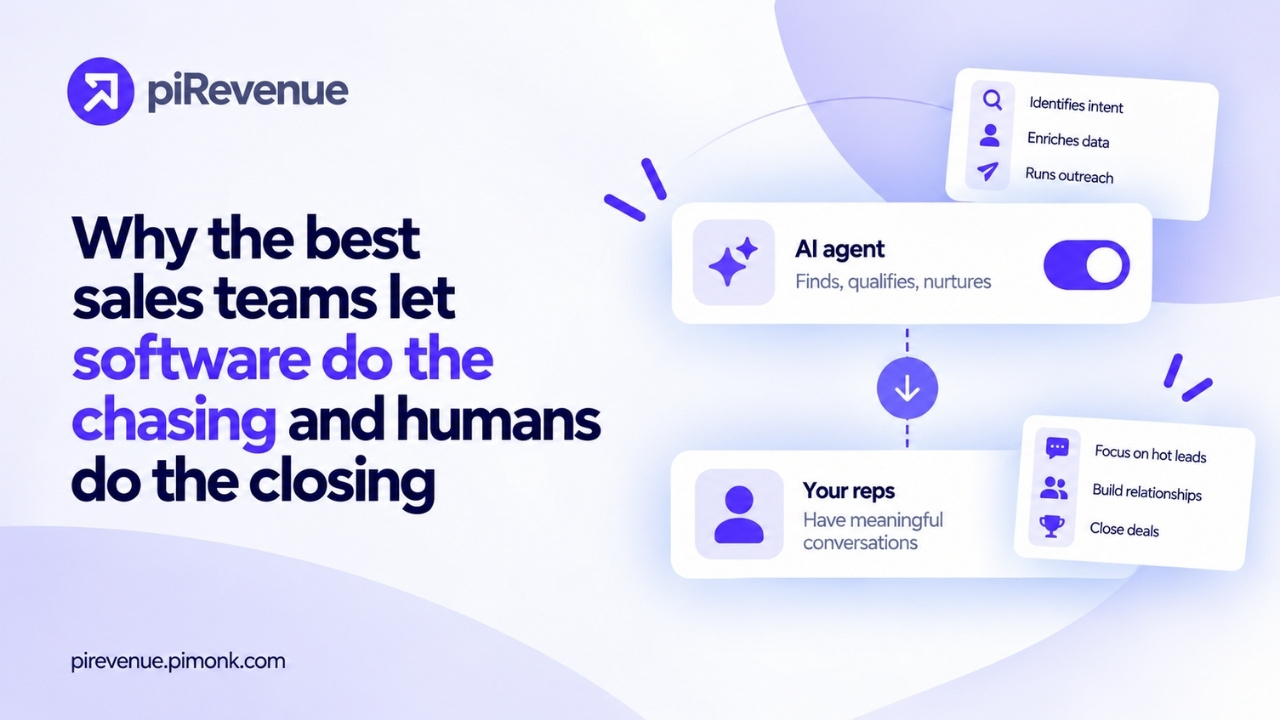
- This is how piRevenue is built. Agents capture, chase and forecast. A person approves everything the customer sees, and there is an audit trail of who did what. The rep's part in chasing becomes approval, not production.
What changes for the sales head?
The pipeline review changes first. When software is already tracking every quiet deal, the manager does not need to spend the meeting asking "did you follow up?" That time goes to the deals that need thinking: how to reach the decision maker, how to handle a pricing objection, whether to walk away. Managers go back to coaching.
The forecast changes next. A forecast built from rep updates reflects rep optimism. A forecast built from real activity, such as buyer replies, meetings held and stages moved, reflects the deals. You also see risk earlier. A deal that went quiet in week three shows up in week three, not in the last week of the quarter.
Capacity changes too. If a rep gets back even part of the time spent on admin and follow-up, they can carry more deals or spend more time on each. For a growing business, this can delay the next hire. For a founder who still sells, it can decide whether any selling happens that week.
Conclusion
Once software handles chasing, the way you judge reps should change. Today, a lot of what separates a good rep from an average one is follow-up discipline. The organised rep wins because they remember to call back. When every rep has reliable follow-up by default, that difference disappears. What is left is the quality of the conversation: how well the rep asks questions, handles objections and builds trust. That should change what you hire for, what you train and what you pay for. Being organised matters less. Being good with buyers matters more.
It also raises the standard in your market. When some sellers follow up on time, every time, buyers notice the ones who do not. Consistent follow-up stops being an advantage and becomes the minimum. Teams that still depend on rep memory will lose deals they never knew were at risk.
One last point for the C-suite. The question is not "should we use AI in sales?" It is "which hours of our sales payroll need a person?" Put your people on those hours. Give the rest to software, and keep a person's approval on anything the customer sees.