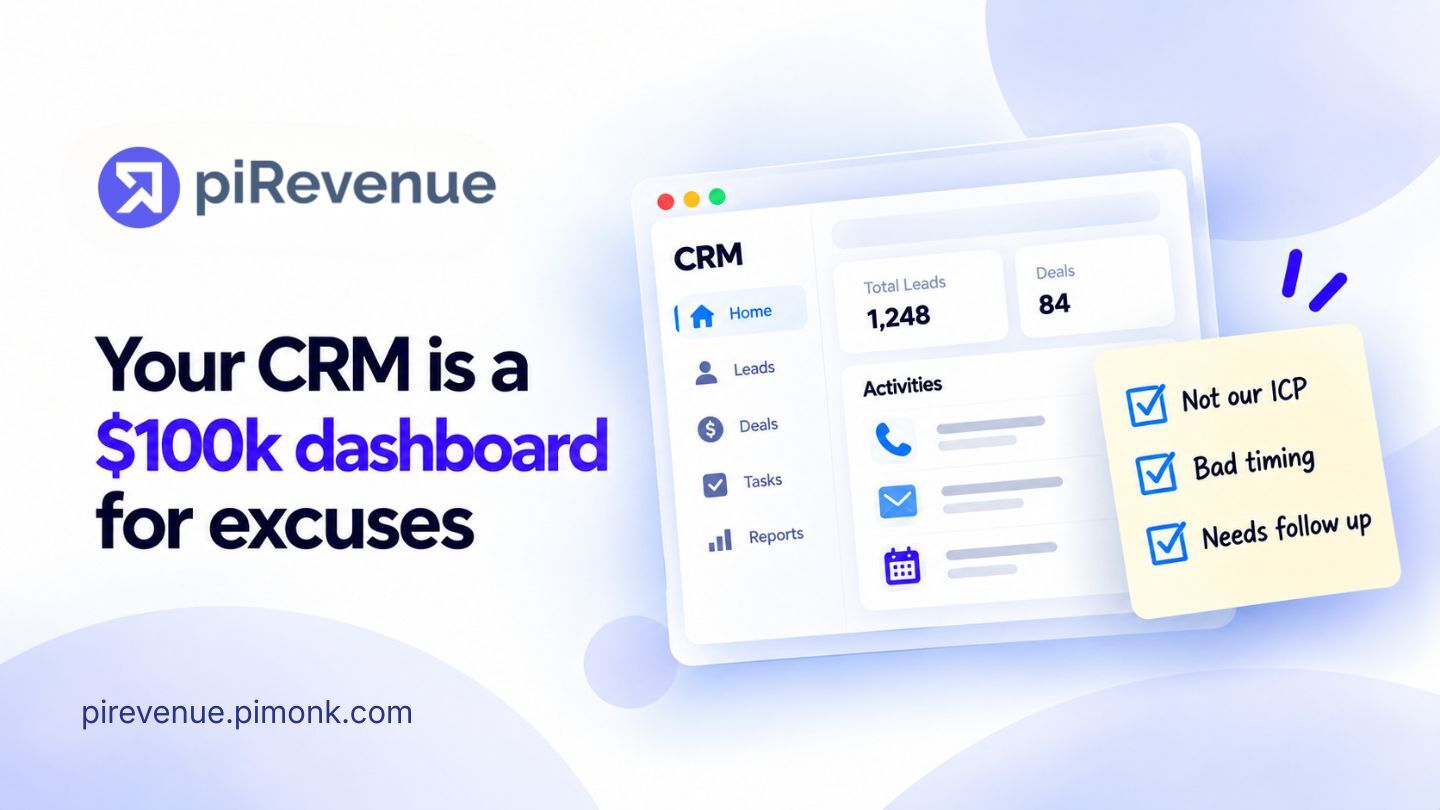
Open the CRM on the last day of any quarter. Every deal that will not close has a reason attached. "Budget pushed to Q1." "Champion left." "Legal review taking longer than expected." "Waiting on procurement." The reasons are neatly logged, colour-coded, and rolled up into a dashboard that senior leaders review on Monday morning. The dashboard cost six figures a year in licences, integrations and the RevOps team that maintains it. What it produces, reliably, is a well-organised list of why the number was missed.
This post is for the CFOs and CEOs who approve that spend and sit through those Mondays. It asks what the company actually gets for the money, why every pipeline review ends with a reason instead of a decision, which excuses the dashboard makes easy, who it is protecting, and how to turn a system that explains failure into one that prevents it.
What does the company actually get for the CRM spend?
A record of what happened, delivered after it happened. That is the honest description of most CRM deployments.
The licences pay for a database and a set of screens. The integrations pay for data to flow into it from email, calendars and calling tools. The RevOps team pays for the reports that turn the data into dashboards. The dashboards show pipeline by stage, forecast by rep, and win rates by segment. All of this is backwards-looking. It describes deals that were created, moved, won or lost.
What the spend does not buy is intervention. The dashboard does not tell a sales leader on the fifth of the month that a deal is going to slip on the twenty-fifth. It tells them on the twenty-sixth that it slipped, and it includes the field where the rep explained why. By then, the only action available is to update the forecast.
Ask the RevOps lead how many deals the CRM helped save last quarter. Not tracked. Save. The answer is usually silence. The system was never built to save deals. It was built to report on them.
Why does every pipeline review end with a reason instead of a decision?
Because the review is structured around the dashboard, and the dashboard is structured around stages and close dates, both of which are entered by the rep.
A typical review goes deal by deal. The leader asks about a deal in "Negotiation" with a close date this month. The rep explains that the buyer's CFO has not yet approved the budget. The leader asks when. The rep says, "Hopefully next week." The leader moves on. Nothing has been decided. A reason has been recorded.
This repeats forty times. At the end, the forecast has been adjusted downward, the reasons have been captured, and everyone has spent two hours confirming what the rep already knew. The meeting was not a decision meeting. It was a narration meeting.
The structure guarantees this. When the leader's only information is what the rep typed, the leader's only move is to ask the rep to explain it. The rep, being asked to explain a slip, produces a reason. Reasons are what the format asks for. Decisions would require information the format does not contain: what the buyer actually said, when they last engaged, whether the champion still replies, whether the timeline was ever realistic.
Which excuses does the dashboard make easy?
The dashboard does not invent excuses. It provides a menu. The common entries and what they usually hide:
-
"Budget moved to next quarter." Usually means there was never a confirmed budget. The deal was qualified on interest, not on money. The dashboard let it sit in late stage because the rep chose the stage.
-
"Champion left the company." Usually means the deal was single-threaded and everyone knew it. A dashboard that showed the number of engaged contacts per deal would have flagged this months earlier.
-
"Waiting on legal." Usually means the rep sent the contract and stopped following up. Legal review that takes six weeks is rarely legal's fault.
-
"Competitor came in late." Usually means the competitor was there from the start and the rep did not ask. The dashboard has no field for "did we confirm we are the only vendor being evaluated."
-
"Buyer went quiet." Usually means the buyer decided against the purchase weeks ago and the rep kept the deal open to protect pipeline coverage. Engagement data would show the last real reply.
-
"Timing wasn't right." Means nothing. It is the excuse chosen when no specific excuse fits.
Each of these is a lagging indicator dressed as a cause. The real cause was visible earlier, in the buyer's behaviour, and the dashboard was not built to show it.
Who is the dashboard protecting?
Not the company. Several people inside it.
It protects the rep. A logged reason is a defence. "It's in the CRM" ends the conversation. As long as the excuse is documented, the rep has done the process correctly, regardless of whether the deal was ever real.
It protects the sales manager. A manager whose team missed can show the dashboard to the VP. Here are the deals, here are the reasons, here is the revised forecast. The manager has reported accurately. Reporting accurately on a miss feels like accountability. It is not.
It protects the sales leader. In the board meeting, the dashboard is the evidence that the pipeline was there and the miss was circumstantial. Budget cycles, macro conditions, a big deal that slipped. The dashboard makes the miss look like weather.
It protects RevOps. A large, well-maintained CRM with clean dashboards is the department's justification. Whether the dashboards change outcomes is a harder question than whether they are accurate, so it is rarely asked.
And it protects the CFO, in a way. The forecast was wrong, but it was wrong in a documented, defensible manner. Finance planned on numbers that sales provided. When the numbers failed, the reasons were on file. Nobody has to say that the forecast method itself is the problem.
The dashboard is a shared arrangement. Everyone gets to be blameless. The company gets the miss.
How does a CEO turn a dashboard for excuses into a system for decisions?
By changing what the dashboard shows from what reps say to what buyers do, and by changing what the review asks for.
-
Replace rep-entered stages with buyer-behaviour signals. Days since last buyer reply. Number of engaged stakeholders. Whether a decision-maker has attended a meeting. Whether pricing has been discussed. These are facts the system can capture from email, calendar and call data without a rep typing anything.
-
Flag risk before the close date, not after. A deal with no buyer activity in fourteen days is at risk regardless of its stage. Surface it in week two, not on the last day of the quarter. AI agents can do this continuously.
-
Change the review question. Not "what's the update?" but "what will happen if nothing changes, and what are we doing about it?" The first question invites narration. The second requires a plan.
-
Require a next step with a buyer's name and a date. Any deal without one is not in the forecast. This one rule removes most of the "went quiet" excuses, because the deal is removed before it can go quiet.
-
Track excuse categories over time. If "champion left" appears in ten per cent of lost deals every quarter, the problem is qualification, not bad luck. The dashboard should show patterns in the reasons, not just the reasons.
-
Measure the dashboard on saved deals. Ask RevOps for a number: deals flagged at risk, acted on, and closed. If they cannot produce it, the dashboard is still a reporting tool.
Conclusion
Excuses are what a dashboard produces when it shows outcomes instead of behaviour. Outcomes always have a story, and the story is always available after the fact. Behaviour does not need a story. It is just what the buyer did or did not do, visible while there is still time to respond.
The real issue is timing. Every excuse in the CRM is true. The budget did move. The champion did leave. The buyer did go quiet. But every one of those was visible weeks before it became an excuse, in the buyer's silence, in the missing stakeholder, in the meeting that was never booked. The dashboard was built to record the outcome, so it recorded the outcome, and the moment when something could have been done passed unrecorded.
A hundred thousand dollars was spent to make the miss explainable. The same money, pointed at behaviour instead of outcomes, would make the miss avoidable. Those are different products. Most companies bought the first one and are still waiting for it to behave like the second.