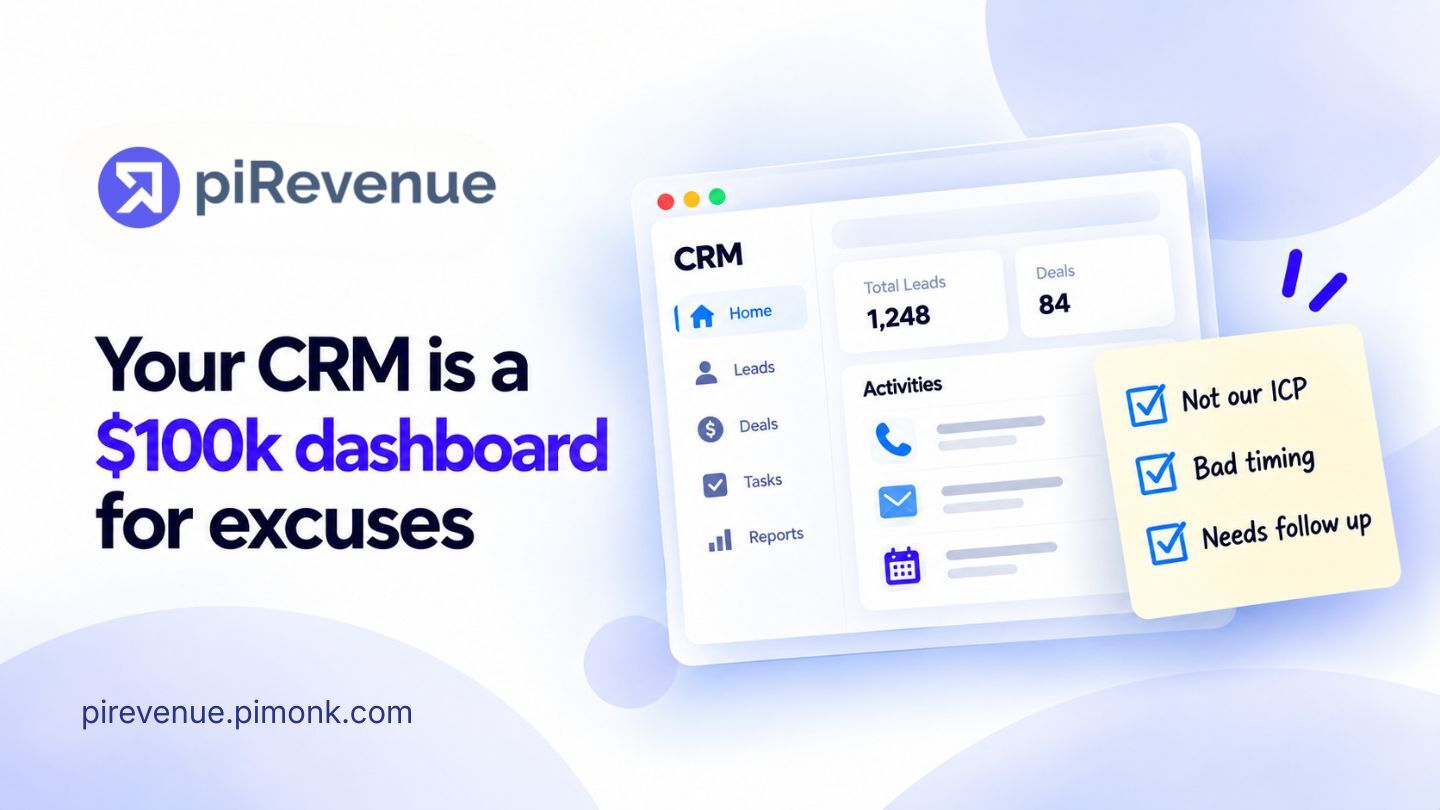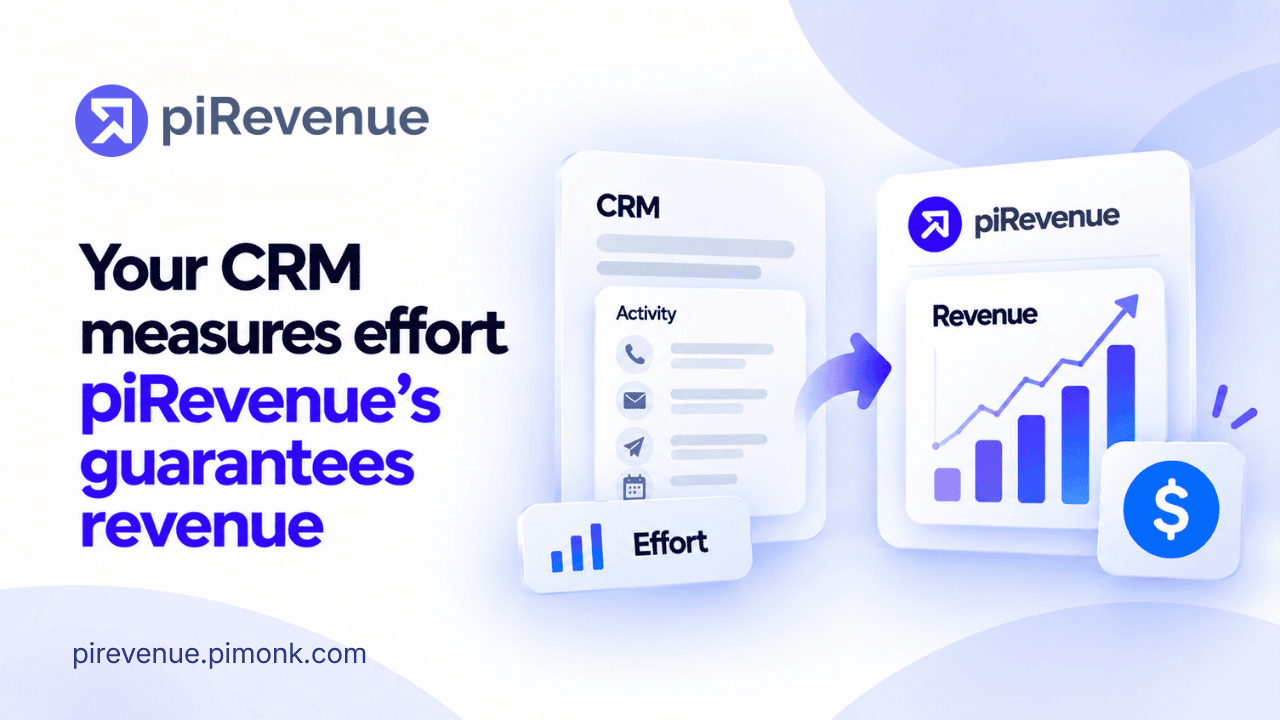
Every CRM dashboard answers the same question: what did the reps do? Calls logged. Emails sent. Stages updated. Notes entered. The system was built to record effort, and it does that well. What it cannot do is turn effort into money. A rep can log 200 activities a week and close nothing. The CRM will report a busy week. The CFO will see a full pipeline. And the quarter will miss, with every excuse neatly recorded in a field.
This post is for sales heads, CFOs, and CEOs who pay for that dashboard and wonder why it never predicts anything. It explains what a CRM actually measures, why measuring effort produces no revenue, what piRevenue does differently, how a system can guarantee anything when humans still close the deal, and what finance should compare when it is time to replace the CRM.
What does a CRM actually measure?
A CRM is a system of record. Its job is to store what already happened. Reps feed it. Every field a rep fills is a small act of obedience to the process, and every empty field is a small act of rebellion. Managers spend their time policing the gap between the two. The dashboard reports how well the policing is going.
This is why the numbers look like effort. Activities logged is a count of how many times reps did what the process asked. Pipeline coverage is a count of how many deals reps were willing to enter. Stage distribution shows which stage reps chose. None of these is facts about buyers. All of them are facts about how reps interact with software.
The CRM is honest about this in its own way. It never claimed to know whether a deal would close. It claimed to store what the rep said about it. Leaders forgot the difference.
Why does measuring effort produce no revenue?
Because effort is an input, and inputs only matter when they are pointed at the right output. The CRM has no way to check the direction.
A rep making calls to the wrong accounts is producing effort. A rep sending follow-ups to a buyer who decided against the purchase three weeks ago is producing effort. A rep updating twelve deals to "Negotiation" on the last day of the quarter is producing effort. The CRM records all of it as activity. Management reads the activity as progress.
There is a second problem. Effort that has to be logged by hand gets logged selectively. Reps enter what makes them look good and skip what does not. The record is not a record of effort. It is a record of the effort the rep chose to report. That is worse than no data, because it looks like data.
And there is a third. Every hour spent feeding the CRM is an hour not spent with a buyer. Directional estimates suggest reps spend most of their working time on busywork rather than selling. A system that consumes selling time to produce a record of selling effort is working against its own purpose.
Revenue comes from buyers taking action. The CRM does not see buyers. It sees reps typing.
What does piRevenue do that a CRM does not?
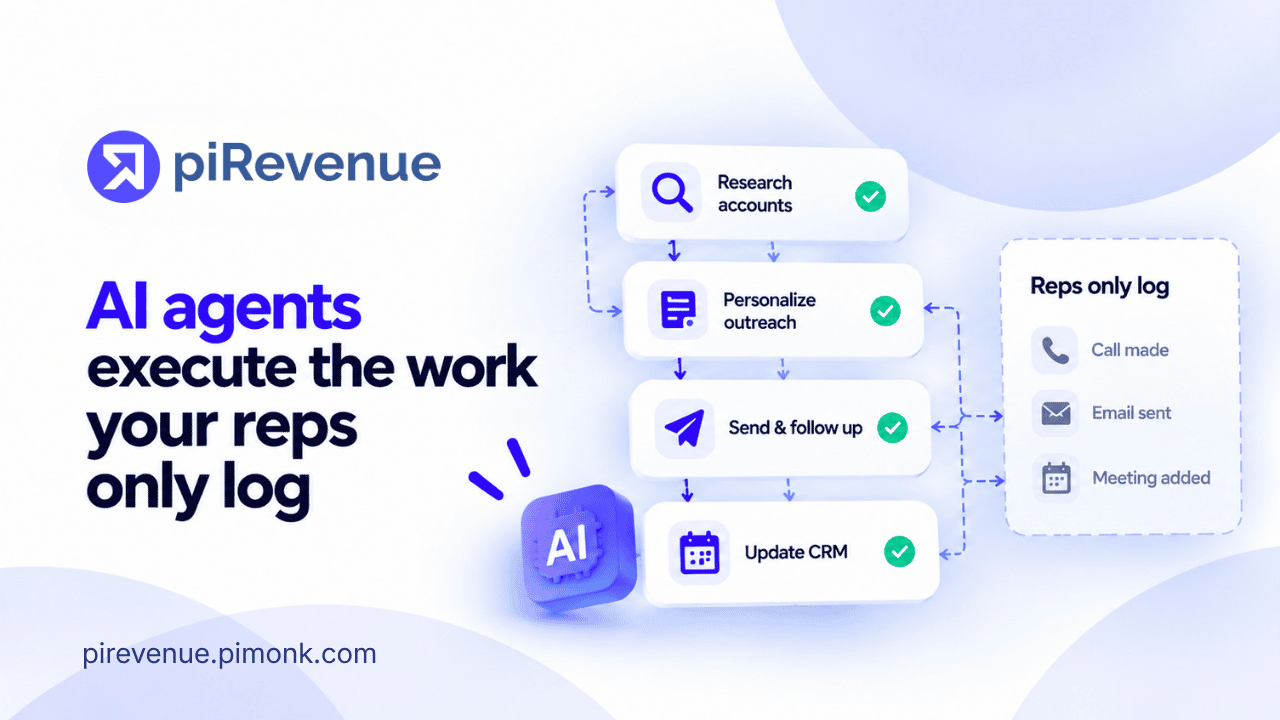
It does the work, then records it. The record is a by-product, not a task. Four things in practice:
- Auto-capture: A voice note after a meeting, a forwarded email, a message from the road. An agent turns it into a structured deal: contact, value, stage, next step. No form. No end-of-day entry. The rep never feeds the system. The system reads the work.
- Agentic follow-up: When a deal goes quiet, an agent notices before the rep does. It drafts the nudge in the rep's voice, proposes the next step and flags the risk. The rep approves with one tap or edits it. Nothing sits unattended because someone forgot.
- Live forecast: The number updates itself from real activity. Not from what reps typed on Friday. Not from optimism. A weighted pipeline value that leadership can take into a board meeting and defend, because it was built from what buyers did.
- Human-in-the-loop: Every customer-facing action is approved by a person. Every price, every commitment, every outbound word. Agents handle the busywork. Humans own the relationship and the close. The audit trail shows who did what.
The difference is not features. A CRM asks reps to prove they worked. piRevenue removes the need for proof, because the work is captured as it happens. The dashboard stops measuring effort and starts showing the state of every deal.
How does a system guarantee revenue when humans still close?
It does not close deals. It guarantees that nothing between the first conversation and the close gets dropped. That is where revenue is actually lost.
Most missed quarters are not lost in the negotiation. They are lost in the gaps. A deal that went quiet and nobody chased. A contact that changed and nobody updated. A next step that was agreed in a meeting and never written down. A wrong forecast because it was built from stale entries. Each gap is small. Together, they are the difference between the number and the miss.
piRevenue closes those gaps by design. Every deal is captured, so none are forgotten. Every quiet deal is flagged and a follow-up drafted, so none go cold by neglect. The forecast reflects live activity, so leadership is never surprised by a slip that was visible weeks earlier. The human still decides. The human still closes. But the human is never the reason a deal fell through a crack in the process.
That is what the guarantee means. Not that every deal will close. That every deal will get the attention it needs to have a chance. A CRM cannot promise that, because a CRM depends on reps remembering. piRevenue does not.
What should a CFO compare when replacing a CRM?
Not licence prices. Total cost of the arrangement, and what it produces.
- Cost of the stack: A typical enterprise setup layers a CRM, a call recorder, a data provider, a sequencing tool and routing software, plus a RevOps function to wire them together. For a ten-rep team that runs into tens of thousands a year. piRevenue does the core cycle in one platform at a fraction of the cost. The comparison page on the site lays out the directional math.
- Rep hours recovered: Estimate the time each rep spends on logging, chasing and forecast preparation. Multiply by rep cost. That is what the CRM is consuming. Most of it comes back.
- Deals that would have gone cold: Ask the sales head how many deals were lost last year to silence rather than to a competitor. Those are recoverable with agentic follow-up. Put a number on them.
- Forecast accuracy: Compare forecast to actual for the last four quarters. If the gap is large, finance has been planning on fiction. A live forecast built from activity narrows it.
- Time to live: A CRM implementation takes months and a consultant. piRevenue is live in an afternoon with a free trial. Time to value is a cost too.
- Currency and region: For teams across India, the Middle East, Southeast Asia and Africa, pricing in local currency from day one matters. Enterprise CRMs are priced in dollars for headquarters. piRevenue is priced for where the team sells.
Conclusion
The CRM measured effort because, for twenty years, effort was the only thing management could see. Revenue arrived late. Buyer behaviour was invisible. So leaders counted what reps did and hoped it correlated. That was reasonable once. It is not reasonable now.
What changed is that the work itself became readable. A conversation, a voice note, an email thread. Agents can read them and act on them. When the record is a by-product of the work, nobody has to prove effort, because effort is no longer the question. The question becomes: what is the state of every deal, and what needs to happen next? That is a question about revenue, not about reps.
Here is the insight most leaders miss. A system that measures effort makes reps work for the software. A system that does the work makes the software work for reps. Those are opposite arrangements, and they cannot coexist. A company has to choose which one it is running. piRevenue is built on the second. Most CRMs are still built on the first, and they will keep measuring effort until someone decides that effort was never the point.