Open any rep's CRM and look at the "next step" field. "Send proposal." "Follow up Thursday." "Confirm budget with CFO." "Schedule demo." These are not records of work. They are records of work that has not happened yet. The rep typed a promise, and the system stored it. Whether the promise gets kept depends on the rep remembering, having time, and not being pulled onto something else. Most of the time, some of those promises expire quietly. AI agents change this in one specific way. They do not log the next step. They do it.
This post is for the sales heads, CFOs and CEOs who have spent years reading pipelines full of intentions. It explains the difference between logging work and doing it, which tasks agents actually execute, why the CRM stopped at logging, where agents must stop and hand over to a person, and what a sales head gains when execution leaves the rep's to-do list.
What is the difference between logging work and doing it?
When a rep logs "send follow-up email," three things have happened. The rep has thought about the deal. The rep has decided what should happen next. The rep has recorded that decision. Nothing has reached the buyer. The email does not exist. The deal is exactly where it was.
Now the rep has a list of such entries, one per deal, thirty or forty deep. Each one is a task waiting for the rep to return to it. The rep returns to some of them. The others sit until the close date passes, at which point the entry is updated to a new close date and a new next step, and the cycle repeats.
The CRM reports all of this as pipeline activity. Stages were updated. Next steps were entered. Notes were added. The dashboard shows a busy, well-maintained pipeline. The buyer has heard nothing.
This gap between the log and the action is where deals die. Not in the negotiation. In the fourteen days between "follow up Thursday" being typed and the follow-up actually going out.
Which tasks do AI agents actually execute?
The ones that follow from a conversation and require no new judgement. In a typical deal cycle:
-
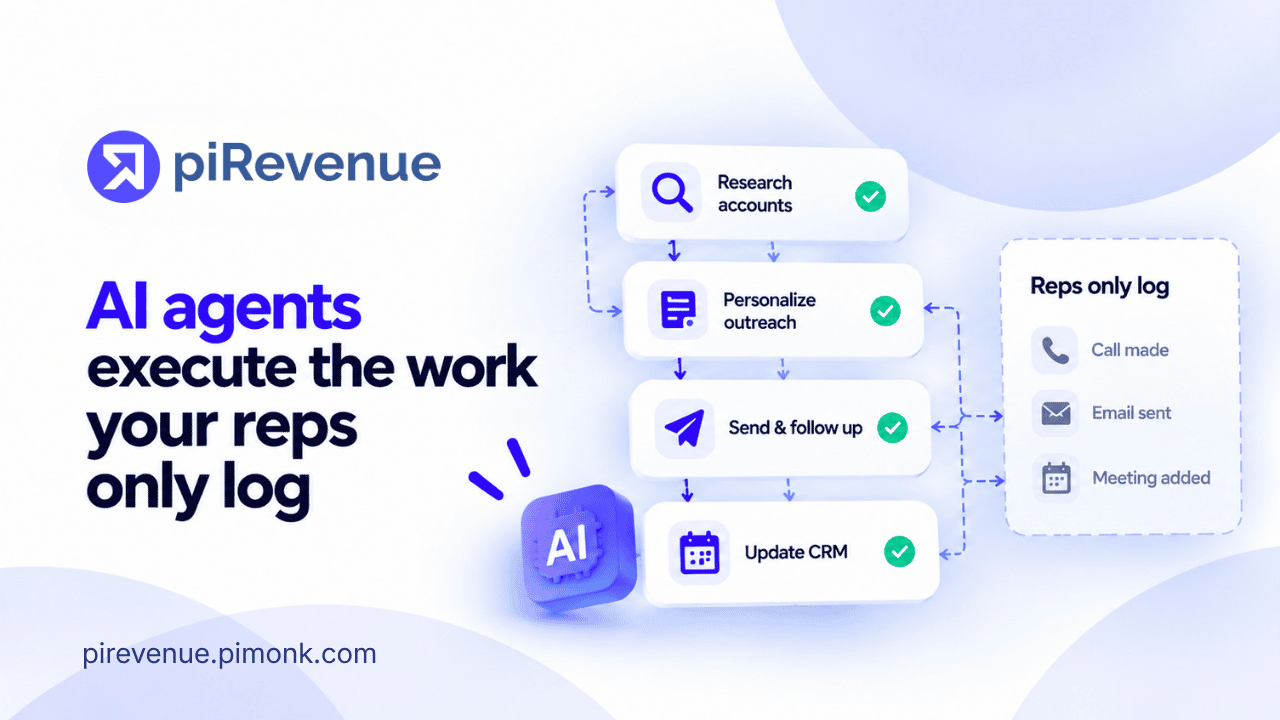
Structuring the deal from the conversation: A voice note after a meeting or a forwarded thread becomes a complete record: contact, role, value, stage, agreed next step. The agent writes it. The rep does not.
-
Sending the follow-up: The agent drafts it in the rep's voice, based on what was discussed. The rep approves with one tap. It goes out that day, not "Thursday" in the sense of "when I get to it."
-
Booking the next meeting: Proposed times, sent to the buyer, confirmed, added to both calendars. The agent handles the back-and-forth.
-
Chasing the quiet deal: The agent notices when a buyer has gone silent past a threshold, drafts a nudge, and puts it in front of the rep. The rep decides whether to send. The deal does not sit forgotten.
-
Updating the forecast: As deals move, the number moves. Nobody reconstructs it on Friday from memory.
-
Preparing the rep for the next call: Account history, last conversation, open objections, who else is involved. Assembled before the meeting without the rep asking.
-
Flagging risk: Champion stopped replying. Close date inconsistent with stage. No decision-maker engaged. Surfaced when it happens, not at the quarterly review.
Why did the CRM stop at logging?
Software could store text. It could not read an email and understand what was agreed. It could not write a follow-up in a person's voice. It could not notice that a buyer had gone quiet and decide that mattered. All of that required a human. So the CRM was built as a place for the human to write things down, and the doing was left to the human as well.
This was a limitation, not a design choice. But it shaped twenty years of sales management. Because the system could only log, managers could only inspect logs. Because managers inspected logs, reps optimised the logs. The whole structure of pipeline reviews, activity dashboards and forecast calls grew around a system that could describe work and could not perform it.
The vendors reinforced this. A CRM that logs is a system of record, and systems of record are easy to sell to leadership: one place for everything, complete history, full visibility. The fact that the visibility was into descriptions rather than actions was not mentioned. Nobody asked how many of the logged next steps were ever completed, because the system did not track that either.
AI agents remove the limitation. The system can now read, write, schedule, chase and forecast. The question is no longer what happened. It is what still needs a person.
Where must AI agents stop and hand over to a person?
At every point where the buyer will hear from the company, and at every point that requires judgement about the deal. This line is not optional. It is what makes execution by agents safe.
-
Before anything is sent: Every follow-up, every nudge, every proposal. The agent drafts. The rep approves. One tap if the draft is right. An edit if it is not. Nothing reaches a buyer without a human deciding it should.
-
Before any commitment: Price, timeline, scope, terms. The agent can prepare the options. The rep makes the promise, because the rep is the one who will be held to it.
-
When the buyer's behaviour changes: A new stakeholder appears. A tone shifts. An objection is raised that was not there before. The agent flags it. The rep decides what it means.
-
When the deal should be dropped: The agent can show that a deal has been quiet for six weeks and the champion has left. Only the rep, with the sales head, decides to close it as lost. That is a judgement about the relationship, not about the data.
-
When the answer is not in the rules: Every agent runs on rules the company wrote. When a situation falls outside them, the agent stops and asks. The company should see those questions, because each one is a rule that needs writing.
-
At the close: The agent has done everything up to this point. The rep negotiates and closes. The win is the rep's. The audit trail shows the agent prepared it.
The principle is simple. AI agents execute the work that was only ever logged. Humans own the decisions that were always theirs. A company that blurs that line will lose trust with buyers and with reps. A company that keeps it gets execution without losing control.
What does a sales head gain when execution moves to agents?
Time first. Reps stop maintaining lists of intentions and start spending their day in conversations. The hours that went into logging, chasing and forecast preparation come back. The sales head stops spending Friday reconciling and Monday inspecting.
Accuracy second. The pipeline stops being a collection of promises and becomes a record of what actually happened. Every follow-up either went out or did not. Every meeting was either booked or not. The forecast reflects deals that are moving, not deals that reps intended to move. The number the sales head takes to the CFO is defensible because it was not typed by anyone.
Visibility third, and this is the one that changes the job. The sales head can now see execution rather than description. Which deals had their follow-up sent within a day. Which reps approve agent drafts without edits, and which rewrite everything. Where the agents are asking questions because the rules are unclear. This is information about how the sales motion actually runs, and no CRM has ever provided it.
What the sales head gives up is the role of inspector. There is nothing to inspect. The work is done or it is flagged. The job becomes setting the rules, coaching the reps on the conversations that matter, and deciding the exceptions. Most sales heads find that is the job they wanted in the first place.
Conclusion
A log is a promise. Execution is delivery. For twenty years, the CRM has been accumulating promises, and sales leaders have been managing a pipeline made of them. The stages were intentions. The next steps were intentions. The close dates were intentions. The forecast was a sum of intentions, presented as a number.
AI agents turn intentions into actions at the moment they are formed. The follow-up is sent. The meeting is booked. The quiet deal is chased. The record is what happened, because the agent made it happen and then wrote it down. This is a different kind of pipeline. It is not a list of what reps mean to do. It is a list of what has been done and what needs a person next.
Here is the practical test for whether a company has made this shift. Look at the "next step" field. In a logging system, it is full, and most entries are overdue. In an executing system, it is nearly empty because next steps are completed within hours and replaced by the next one. A pipeline with no stale next steps is not a sign that reps are diligent. It is a sign that nobody is relying on reps to be. That is the point. The rep's job is the conversation. Everything else was only ever supposed to be logged because nothing could do it. Now something can.