Ask a sales rep how many clicks it takes to log a call. Then ask how many to update a deal stage, add a contact, and set a follow-up. Most will not know, because they stopped counting. The answer is usually between 30 and 50. Multiply that by every interaction in a week. That is the job. Not selling. Clicking. The CRM was sold as a tool for reps. It became a reporting system that reps feed.
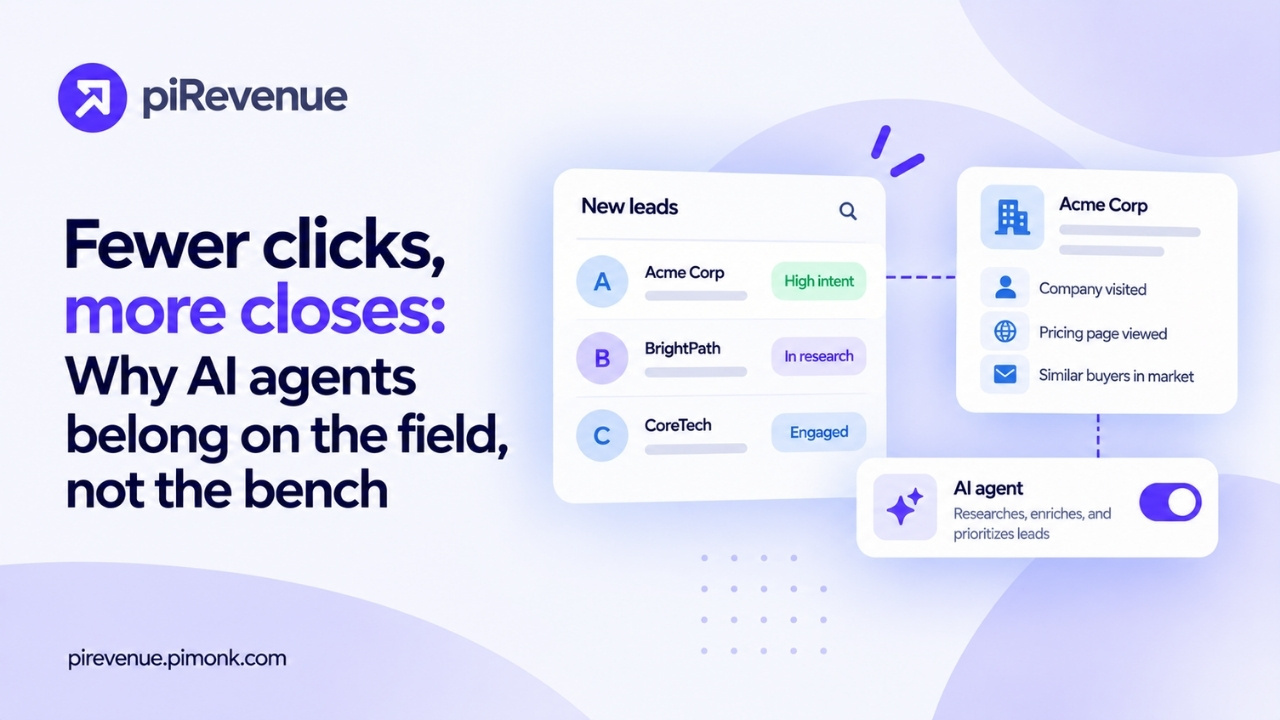
AI agents were supposed to fix this. In most companies, they have not, because they were deployed to summarise the reporting rather than replace the clicking. They sit beside the workflow, drafting emails and writing call notes, while the rep still does the data entry. That is the bench. This post is about getting them onto the field, where the work is.
Is your CRM a sales tool or a reporting tool?
Be honest. Who does the CRM serve?
If it serves reps, it should make the next action obvious and easy. It should surface what matters about the account before the call. It should handle the admin after the call without being asked. Reps should want to open it.
If it serves management, it exists so that pipeline reviews have numbers. Reps update it because they are told to, usually the night before the forecast call. The data is late, incomplete and shaped to avoid difficult questions. Everyone knows this. The forecast is built on it anyway.
Most CRMs are the second kind. This is not a criticism of the software. It is a description of how it was implemented. Every mandatory field, every required stage, every "please update your opportunities" email pushed the system toward reporting and away from selling.
The clicks are the tax that reps pay so that leadership can see a dashboard. AI agents can pay that tax instead. That is the whole opportunity.
What does "on the bench" look like in practice?
Bench deployments are easy to spot. The agent is present, but the rep's day has not changed.
A rep finishes a call. The AI writes a summary. The rep reads it, edits it, copies it into the CRM, updates the stage, sets the task, and moves on. The summary saves two minutes. The clicks are the same.
A rep is prospecting. The AI drafts the email. The rep pastes it into the sequencing tool, picks the contact, adds it to the CRM, and sends. The draft is saved in four minutes. The workflow is unchanged.
A manager wants a forecast. The AI produces a summary of the pipeline. The pipeline is still full of stale deals because nobody updated them. The summary is accurate and useless.
In each case, the agent did something helpful and nothing structural. It is on the bench because it is not allowed to act. It can only suggest. The rep remains the interface between the agent and the systems, which means the rep is still doing the clicking.
Why do most AI rollouts in sales stay on the bench?
Three reasons, and none of them are technical.
Nobody gave the agent write access. IT and RevOps were comfortable letting an agent read the CRM. Letting it write felt risky. So the agent can see everything and change nothing. That decision alone guarantees a bench deployment.
The process was designed for humans. Every field, stage and approval was built assuming a person would fill it in. The agent was bolted onto that process rather than the process being rebuilt around the agent. So it fills the same fields, in the same order, with the same friction, just slightly faster.
Leadership measured adoption, not outcome. The success metric was "how many reps used the AI this week." That rewards features that are visible and easy: drafts, summaries. It does not reward the invisible work of removing steps. A rep who never touches the CRM because the agent handles it would score zero on adoption and maximum on value.
Fix these three and the agent moves off the bench. Leave them, and no amount of model improvement will matter.
Which parts of the sales day should AI agents take over?
Everything that is not talking to a customer or deciding what to do about a deal. In practice:
-
CRM updates: After every call, email or meeting, the agent logs it, updates the stage if the criteria are met, adds new contacts, and sets the follow-up. The rep reviews by exception, not by default.
-
Pre-call research: The agent pulls the account history, recent news, open tickets, past objections and the buying committee, and puts it in front of the rep ten minutes before the call. Nobody clicks through six tabs.
-
Sequencing: The agent selects contacts, chooses the sequence, personalises the messages, sends them, and stops when a reply comes in. The rep sees replies, not queues.
-
Pipeline hygiene: The agent flags deals with no activity in 14 days, checks whether close dates are realistic based on stage history, and asks the rep one direct question rather than presenting a list.
-
Handoffs: Lead to opportunity, opportunity to onboarding, renewal to account management. The agent moves the record, notifies the next owner, and carries the context. No form. No Slack thread asking "did anyone pick this up?"
-
Forecast inputs: The agent assembles the numbers from actual activity, not from what reps typed into a field at 11 p.m. Managers review the forecast. They do not chase it.
How does a CFO know the agents are in the field?
Not from adoption dashboards. From changes that show up in the numbers finance already tracks.
-
Selling time per rep: Hours per week in customer conversations, measured from calendar and call data. If agents are in the field, this rises. If it does not move, the agents are on the bench.
-
CRM data completeness without manual entry: What share of records was updated by an agent rather than a person? Aim for most of it. This is the clearest single signal.
-
Forecast accuracy: When the pipeline reflects real activity rather than rep-typed guesses, the forecast tightens. Track the gap between forecast and actual, quarter by quarter.
-
Time to first touch on new leads: Should drop from days to minutes. If it does not, the handoff is still manual.
-
Cost per opportunity: Rep time plus tooling divided by opportunities created. This is what you are paying for. Agents in the field bring it down. Agents on the bench add license cost without moving it.
-
Rep attrition: Reps leave jobs that are mostly admin. When the admin goes, some of the attrition goes with it. This one takes a year to show, but it is real money.
Conclusion
The click count in a CRM is a measure of distrust. Every mandatory field is a place where leadership decided it could not rely on reps to communicate what was happening. The fields multiplied. The clicks multiplied. Reps became data entry clerks with a quota.
AI agents in the field end that arrangement, but not in the way most people expect. They do not make the reps trustworthy. They make the field unnecessary. When the agent logs the call, updates the stage and moves the record, the CRM becomes a byproduct of the work rather than a separate job. The data is better because no human had to choose whether to enter it.
This puts leadership in a new position. For years, the answer to "why did we miss?" was "the data was bad." When agents keep the data, that excuse is gone. The forecast will be accurate. The pipeline will be honest. And the reasons for a miss will be visible in a way they have never been. Some sales leaders will find that liberating. Others will discover that the clicks were protecting them too. The agents belong in the field. The question is whether everyone is ready for what the field will show.