Every quarter, on the last Thursday, I run the same report. It's called "CRM Adoption," and it ranks my sixteen-person team from most to least compliant. Top of the list is whoever logged the most calls, updated the most fields, closed the most tasks. Bottom of the list, this quarter as most quarters, was Sara — who also happened to close the biggest deal of the year, a AED 4.1 million logistics contract with a Jebel Ali distributor she'd been quietly working for five months.
Sara's adoption score was 34%. Her revenue attainment was 187%. Nobody in the DIFC tower where we sit ever asked why those two numbers point in opposite directions. I stopped asking too, for a while, because the report wasn't really measuring what it claimed to measure. It was measuring who had time to fill in forms. And the reps who close the biggest, slowest, most relationship-heavy deals rarely have that time — because they're spending it on the relationship.

A timesheet with a pipeline stage attached
Here's the part nobody says in the sales kickoff deck: a CRM that tracks logged calls, completed tasks, and field-fill percentage is not measuring pipeline health. It's measuring administrative compliance. Rename the "Activity" tab "Hours Logged" and the tool would function identically. We just call it a CRM because it also happens to store the deal.
I don't say this to be cynical about the category. I say it because I ran sales teams for eleven years believing the dashboard was telling me something true about my pipeline, and it took a 34%-adoption, 187%-attainment rep to show me it was mostly telling me who was good at typing.
"A timesheet tells you who showed up. It has never once told you who was about to close."— Omar Al-Rashid, sales director
Why "adoption" was always the wrong metric
Adoption, as an internal KPI, quietly optimizes for the wrong behavior. It rewards reps for narrating their work to a machine rather than doing the work. A rep who spends forty minutes writing up a call spends forty minutes not making the next one. Over a quarter, that trade-off compounds — and it compounds hardest against your best closers, the ones whose calendars are already full of buyer time, not admin time.
Worse, adoption scores create a second, invisible pipeline: the one reps build in their heads, in notebooks, in personal spreadsheets, because updating the "real" system costs more than it returns. By the time that shadow pipeline gets transcribed — if it ever does — the details have gone soft, the urgency has drained out, and the forecast built on top of it is a forecast built on stale memory.
What a CRM has to become
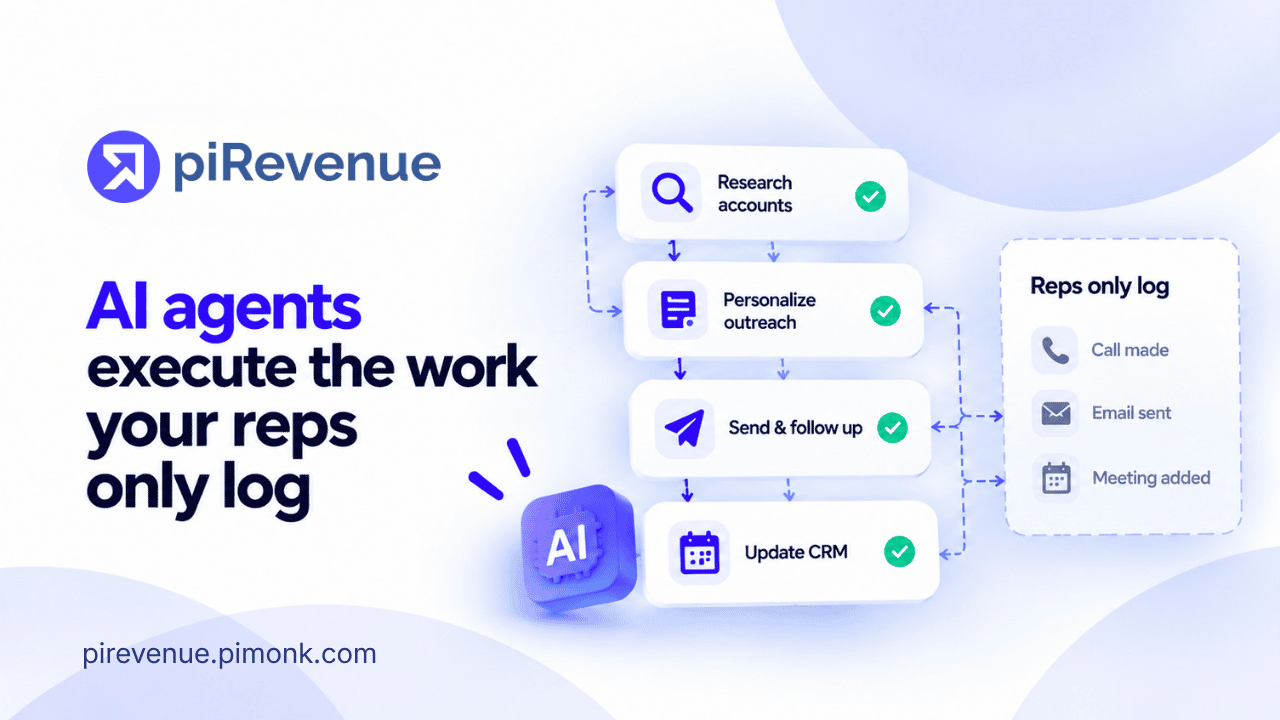
The fix isn't asking reps to type faster, or shaming the bottom of the adoption leaderboard into compliance. It's removing the typing from the loop entirely. A voice note recorded in the car after a client meeting. A forwarded WhatsApp thread. A line dictated between appointments on Sheikh Zayed Road. If the system can turn that raw, already-happening behavior into a structured deal record — contact, value, stage, next step — then "adoption" stops being a separate task competing for a rep's attention. The data capture becomes a byproduct of selling, not a tax on it.
That's the redesign piRevenue is built around, and it's why I moved my team onto it mid-year even though switching CRMs mid-year is, by every rule of sales management, something you're not supposed to do. Sara's adoption score is now irrelevant, because there's nothing left for her to manually adopt. The deal gets captured whether she has forty spare minutes or not.
The conversation I had to have with my own VP
Moving a sixteen-person team off a system my own leadership had standardized on wasn't a popular ask. The first question I got in that meeting was the obvious one: if we stop scoring adoption, how do we know reps are actually working the pipeline? It's a fair question, and it deserves a better answer than "trust them." The honest answer is that we stopped needing to ask reps to prove they were working — the system could see it directly, from the call recordings, the message threads, the response times, without anyone narrating their own diligence into a form. Compliance theatre and actual visibility turned out to be two different things, and we'd spent eleven years optimizing for the theatre because it was the only thing the old tooling could measure.
The second question was harder: what happens to the reps who genuinely were behind on their pipeline, the ones the old adoption score correctly caught? They didn't disappear from view. If anything, they became easier to spot, because a quiet deal — one with no calls, no messages, no forwarded threads in two weeks — gets flagged by the system whether or not the rep remembered to log a task. The signal got sharper. It just stopped being a signal about typing.
The dashboard I actually wanted
What I wanted, eleven years into this job, was a dashboard that told me which deals were at risk, which were genuinely warm, and which number I could defend to my own VP without hedging. Not a leaderboard of who filled in the most fields. Once the busywork stopped being the thing we measured, the forecast started measuring the thing that actually mattered — and Sara, adoption score be damned, has been at the top of every list that counts since.
None of this makes discipline optional. It makes discipline visible in the place it always actually lived — in the buyer's inbox, on the call log, in how fast a deal moves — instead of in a form that measured how well a rep could describe their own week after the fact.
Sara's next quarter
The follow-up worth telling: Sara didn't change how she sells. She still spends most of her week face to face with distributors in Jebel Ali and Al Quoz, still closes slowly and relationally, still would have scored poorly on the old adoption report if we'd kept running it. What changed is that her pipeline is now fully visible without costing her the hours she needs to run it that way. Her forecast entries are auto-generated from real activity, reviewed and adjusted by her in minutes rather than built from scratch. Her next contract — a AED 2.3 million renewal with the same distributor — showed up as an accurate, weighted line in my board deck three weeks before she formally confirmed it, because the system had already seen the signal in her call cadence and message threads. No one had to type that in on a Friday night. It was simply there, because the deal was actually happening.
Humans close deals. Agents can do the logging. The moment you stop confusing the two, the timesheet stops pretending to be a strategy.