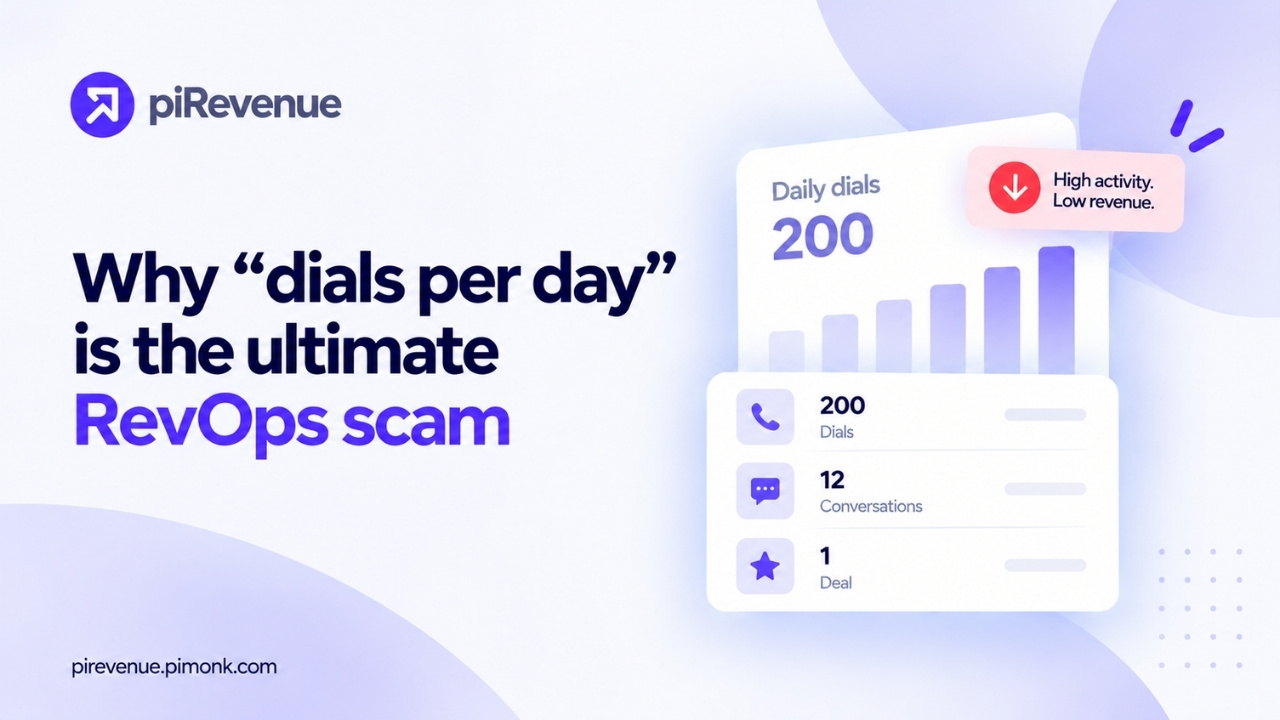
Every sales floor has a number on the wall. Eighty dials. A hundred. Some even go higher. Reps hit it, or they hear about it. Managers report it upward. Finance sees it in the board deck as proof that the team is working. Nobody asks the obvious question: how many of those dials led to anything? The answer, in most teams, is almost none. The number is not measuring sales. It is measuring noise.
This post is for the people who approve sales budgets and sign off on RevOps dashboards. It explains where the dials-per-day metric came from, what it actually tells you, who benefits from keeping it, what it costs, and what you should be looking at instead.
Where did "dials per day" come from, and why is it still here?
It came from a time when there was no other data. Twenty years ago, a sales manager could not see what a rep was doing between nine and six. They could see the phone log. So the phone log became the measure. More calls, more chances, more revenue. The logic was rough but not wrong, because nothing better existed.
Everything has changed since then except the metric. CRMs record every interaction. Call recording captures every conversation. Intent data shows which accounts are in market. Revenue can be attributed to individual touches. A manager today can see almost everything a rep does. And yet the number on the wall is still dials.
It stays because it is easy. Easy to count, easy to compare, easy to explain to someone who does not understand the pipeline. A dial count never requires a difficult conversation about whether the rep is calling the right people. It just requires a spreadsheet.
What does a high dial count actually tell you?
Very little. Here is what it does not tell you.
It does not tell you who was called. A rep who dials 100 numbers from a stale list has done less than a rep who dials 20 that were researched that morning.
It does not tell you what happened. A dial is a dial, whether it reached a decision-maker, a voicemail, a wrong number, or a receptionist who hung up.
It does not tell you what was said. Two reps can have the same connect rate and completely different outcomes because one asks better questions.
It does not tell you what the rep was avoiding. High dial counts often come from reps who are uncomfortable with the harder parts of the job: discovery, negotiation, follow-up on stalled deals. Dialling is a way to look busy while avoiding those.
What a high dial count does tell you is that the rep understood what they were being measured on. That is all. If the number on the wall is dials, you will get dials. You will not necessarily get revenue.
Who benefits when the metric is activity, not outcome?
This is the uncomfortable part, and it is why the metric survives.
-
Managers benefit: Activity is easy to report and hard to argue with. A manager who says "the team made 12,000 calls this quarter" has a defence if the number misses. A manager who says "we had 400 qualified conversations and closed 30" has to explain the other 370.
-
Tool vendors benefit: Dialers, sequencers and engagement platforms sell on volume. Their dashboards are built around activity because activity is what they generate. A vendor whose product makes you call more people has no incentive to ask whether you should.
-
Underperforming reps benefit: Hitting the dial count is achievable regardless of skill. It is a way to stay employed without closing.
-
The CFO does not benefit: Finance is paying for headcount, tooling and data to produce a number that has no reliable relationship to revenue. When the quarter misses, the activity number will still look fine, and nobody will be able to explain why.
How much is the dials-per-day model actually costing you?
More than the salaries. The costs are spread across the P&L, which is why they are hard to see.
-
Wasted headcount. Reps spend a large share of their day on calls that have no chance of converting, because the list was never qualified. That time is a direct cost with no return.
-
Burned lists. Every unqualified dial into a good account makes the next approach harder. High-volume calling damages the very prospects that matter most.
-
Attrition. Reps hired to hit dial counts leave faster. The job is repetitive, the rejection is constant, and the skill they build is not transferable. Replacing a rep costs months of ramp.
-
Bad forecasting. Activity-based pipelines are full of deals that were "created" to justify calls. The forecast inherits the noise. Finance plans on it. The miss arrives late.
-
Tooling spend. Dialers, data providers, sequencing tools, coaching software, all bought to increase or monitor activity. If the activity is not producing revenue, none of that spend is either.
What should the board see instead?
Outcome metrics that a rep can actually influence and that connect to revenue. A short list is better than a long one.
-
Qualified conversations per week. A conversation with a decision-maker at a target account where a next step was agreed. Not a connect. Not a demo request from a form. A real exchange.
-
Conversion from conversation to opportunity. This measures whether the rep is talking to the right people and saying the right things.
-
Opportunity quality. Percentage of opportunities that reach a defined stage within a defined time. Deals that sit for 90 days are not pipeline. They are activity in disguise.
-
Revenue per rep, trailing 90 days. The one number that cannot be gamed by dialling.
-
Cost per qualified conversation. For the CFO. This is what you are actually buying. Track it like any other unit cost.
Notice what is missing. Dials. Emails sent. Sequences launched. Those are inputs. They belong in a manager's coaching view, not in a board deck. If a board is looking at dial counts, the sales leadership has not been asked a hard enough question.
Conclusion
The dials-per-day metric was never really about the reps. It was about the managers. It gave them a way to feel in control of something they could not see. Counting activity was a substitute for understanding the work.
That substitute is now expiring for a reason nobody planned. AI can dial infinitely. Voice agents can make ten thousand calls before lunch. The moment volume becomes free, a metric based on volume is worth nothing. A sales team that measures dials in 2026 is measuring a resource that no longer has a price.
What still has a price is a qualified conversation. Someone with authority, at an account that fits, willing to talk. That is scarce. It will stay scarce. The sales organisations that survive the next few years will be the ones that stopped counting effort and started buying conversations. The rest will have very busy reps, very full dashboards, and very quiet quarters.
Key Takeaways
-
Dials per day measures noise, not sales. The metric survived because it is easy to count and easy to report — not because it has a reliable relationship to revenue. If the number on the wall is dials, the team will produce dials. Not necessarily results.
-
A high dial count tells you one thing: the rep understood what they were being measured on. It does not tell you who was called, what happened on the call, what was said, or what harder parts of the job the rep was avoiding by staying busy.
-
The metric persists because it benefits everyone except the CFO. Managers get a defensible activity story. Vendors sell volume. Underperforming reps stay employed. Finance pays for all of it and gets a forecast built on noise.
-
The costs are spread across the P&L, which is why they stay invisible. Wasted headcount, burned prospect lists, faster rep attrition, bad forecasting, and tooling spend that produces no revenue — none of it shows up on the same line as the dial count that caused it.
-
AI has made the dials-per-day model obsolete. When voice agents can make ten thousand calls before lunch, volume is no longer scarce. What remains scarce is a qualified conversation with a decision-maker at a target account who is willing to talk. That is what sales organisations should be measuring and buying.