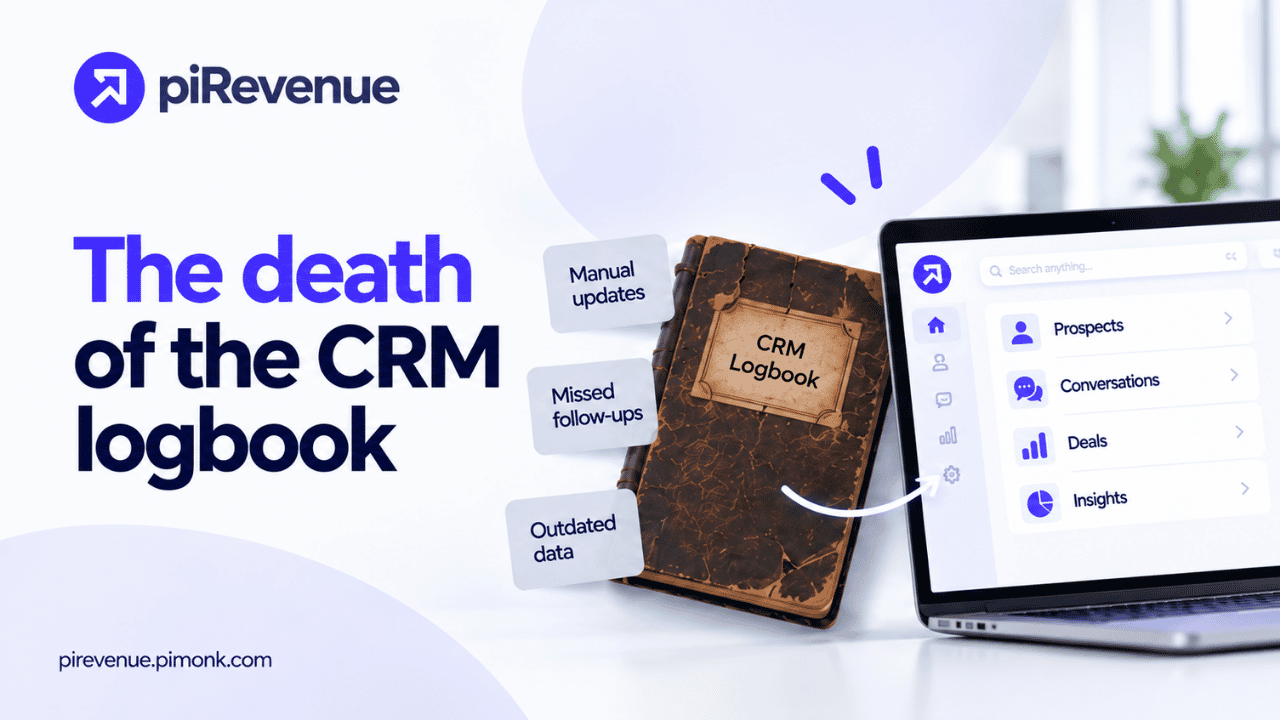
"If it's not in the CRM, it didn't happen." Every sales leader has said it. Most have it on a slide. It was the rule that kept the logbook alive: reps wrote down what they did, managers read what was written, and the company treated the writing as the truth. That rule is now dead. Not because reps have got better at logging. Because the logging is no longer necessary. Every call, email and meeting already exists as data. A system can read it. The logbook, the part of the CRM where humans type what happened, has nothing left to do.
This post is for the leaders who built their sales management around that logbook. It looks at what the logbook was good for, when it stopped paying its way, what replaces it, what leaders lose when it goes, and what to do about the CRM contract you are probably about to renew.
What was the CRM logbook ever good at?
Be fair to it. For twenty years it solved a real problem.
Before the logbook, sales knowledge lived in people's heads. When a rep left, the accounts left with them. When a rep was sick, nobody knew what had been promised. When a deal went wrong, there was no record of where. The logbook fixed that. It created institutional memory where there had been none.
It also gave managers a way to coach. Reading a rep's notes on a lost deal was the closest a manager could get to being in the room. It was second-hand and incomplete, but it was something.
And it gave finance a forecast. Crude, rep-shaped, often wrong, but a number that could be planned against. Before the logbook, finance planned on the sales head's gut.
Those three things, memory, coaching and forecasting, were real gains. The logbook delivered them at the cost of rep time and data quality, and for a long time that trade was worth making. The trade is not worth making any more.
When did the logbook stop being worth the cost?
The turning point was not a single product launch. It was the moment the work itself became fully recorded.
Calls are recorded and transcribed. Emails sit in a mailbox the CRM can read. Meetings happen on platforms that produce transcripts. Messages live in tools with APIs. Proposals are sent from systems that know when they were opened. Contracts are signed on platforms that log every step.
At some point in the last few years, the record of what a rep did became more complete in the raw data than in anything the rep could type. A transcript captures the objection the rep forgot to note. An email thread shows the close date slipping before the rep updated the field. The logbook became a worse copy of information that already existed.
Once that happened, every hour spent on the logbook was an hour spent producing a degraded version of the truth. Leaders kept demanding it anyway, because the process said so and because reading the raw data was hard. It is no longer hard. AI agents read it, structure it, and write it to the CRM without a human touching a keyboard. The cost of the logbook is now pure waste.
What replaces the logbook, and what does the CRM become?
The logbook is replaced by capture. The CRM changes from a place where people write to a place where the system records.
In practice:
-
Every interaction is captured at source: Call, email, meeting, message. The agent extracts who was involved, what was discussed, what was agreed and what changed.
-
Stages become evidence-based: "Proposal Sent" means a proposal was sent. "Negotiation" means the buyer raised terms. No rep picks a stage. The system reports one.
-
Contacts and roles update themselves: A new name on an email thread becomes a contact. A title in a signature becomes a role. The buying committee builds itself.
-
Risk is detected: A deal goes quiet for two weeks, and the system flags it. A champion leaves the company, and the system notices from the bounce. Nobody waits for a rep to admit the deal is stalling.
-
The rep adds judgment, once: The only thing the system cannot capture is what the rep thinks. So the system asks one question per deal per week. That is the whole human contribution.
What do leaders lose when the logbook dies?
This is the part that gets skipped in vendor decks. Leaders lose something real, and it is better to name it.
They lose a compliance metric. "CRM hygiene" was an easy way to judge reps. Did they log? Did they update? A rep who kept the logbook clean looked disciplined even if they closed nothing. When capture is automatic, that metric vanishes. Managers have to judge reps on outcomes and judgement, which is harder and more exposed.
They lose the comfort of a curated story. Rep notes were written for the reader. They explained, softened and framed. A transcript does not. Leaders reading the captured record will see deals as they are, including the calls where the rep was outmatched and the emails where the buyer was politely saying no. Some leaders will not enjoy that.
They lose the excuse. When the forecast was missed, "the CRM data was bad" was always available. With automatic capture, the data is the record of reality. A miss now means the pipeline was never what it looked like, and the leader who presented it should have known.
None of these losses is bad for the company. They are bad for leaders who relied on the logbook to avoid harder conversations. That is a leadership question, not a technology one, and CEOs should ask it directly of their sales heads before the rollout, not after.
What should a CEO or CFO do with the CRM contract now?
Most CRM contracts were priced for the logbook era. Seats, fields, storage, and a long list of modules built to make humans enter data faster. Much of that is about to be irrelevant. Before the next renewal:
-
Count the seats you actually need: If reps no longer live in the CRM, fewer of them need full licences. Many need read access or none. Vendors price per seat. Do not renew the old count.
-
Ask what the vendor's capture story is: Every major CRM now claims AI. Ask specifically: does it write records from calls, emails, and meetings without a human, and can you audit what it wrote? A drafting assistant is not capture.
-
Demand open access to your own data: Automatic capture works best when the agent layer can read everything and write everything. A vendor who meters API calls or blocks third-party agents is protecting the logbook, not you.
-
Cut the modules that exist for data entry: Guided selling forms, mandatory field enforcement, activity scoring. If no human is entering data, these have no job.
-
Shorten the term: The CRM is moving from a system of engagement to a system of record. Systems of record are commodities. Do not sign five years for a commodity.
-
Separate the agent spend: The value now sits in the layer that reads the work and writes the record. That layer should be yours, or at least not tied to the CRM vendor's roadmap.
Conclusion
The logbook was never really about data. It was about compliance. Filling it in was how a rep showed they were doing what they were told. Reading it was how a manager showed they were paying attention. The information was almost secondary. That is why it survived so long after better information existed.
Its death changes who the CRM serves. For two decades it was management's instrument, built to watch the sales team. Now it becomes the company's memory, built from the work the sales team actually does. That memory belongs to the business, not to any manager's dashboard, and it will outlast every rep, every sales head and probably every CRM vendor.
The question leaders should be asking is not "how do we get reps to log more?" It is "who owns the memory once no one is writing it." Whoever controls the capture layer controls what the company knows about its customers. Right now, in most firms, nobody has decided who that is. Decide before the vendor does.