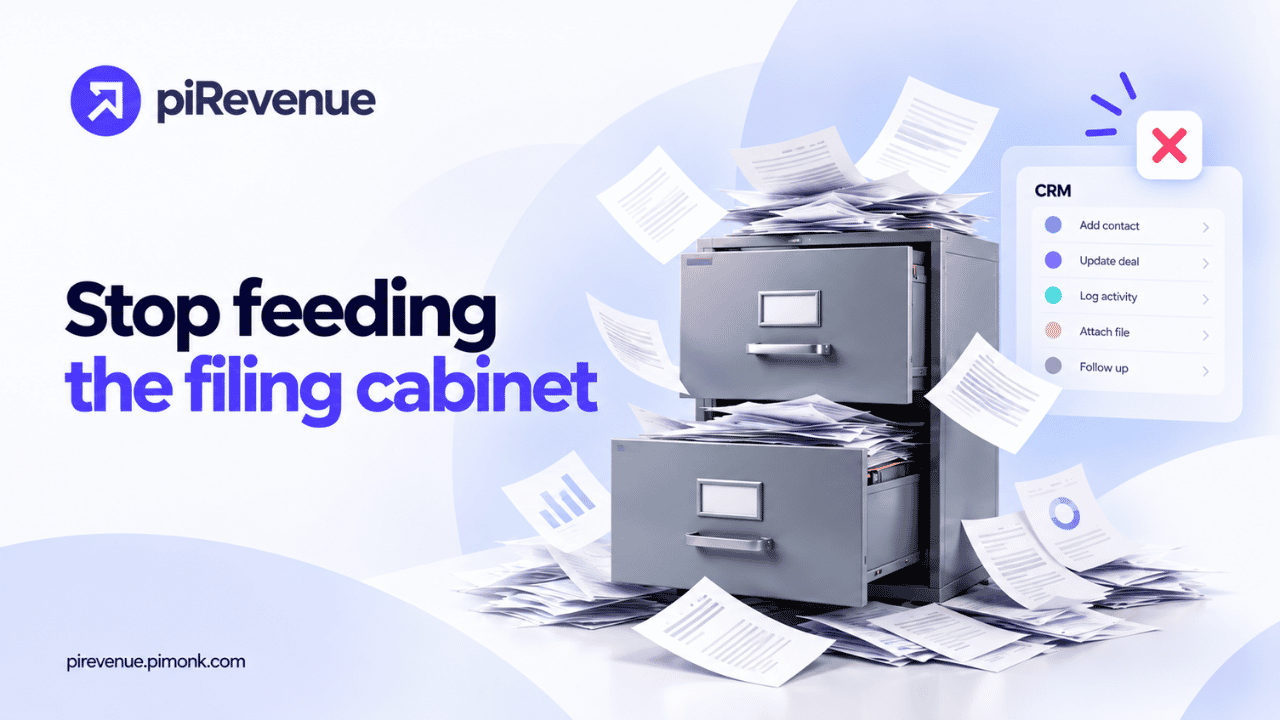
Your CRM is a filing cabinet. Reps put things in. Managers occasionally take things out. Most of what goes in is never read by anyone. It exists so that, if someone asks, there is a record. Every week your sales team spends hours creating that record. Every week finance pays for those hours. And every quarter the forecast built on those records is wrong, because the records were filled in by people who wanted the forecast meeting to end.
This post is for the leaders who keep the cabinet running. It puts a number on what feeding it costs, explains why the data gets worse the harder you push for it, and lays out what reps should be doing instead. It ends with how to stop feeding the cabinet without losing the visibility it was supposed to provide.
How much of your sales team's week goes in and never comes back out?
Most sales leaders have never measured this. Do it once, and the number is hard to forget.
Take a rep with 25 customer interactions a week. Each one needs logging: the call, the notes, the stage, the next step, the new contact, the updated close date. Call it eight minutes per interaction if done properly. That is over three hours a week. Add the Friday pipeline scrub before the forecast call, the monthly territory review, the quarterly account planning template. Most reps land between five and eight hours a week feeding the system.
Now ask what comes back out. The rep gets a task reminder. The manager gets a dashboard. Finance gets a forecast. Of those, only the task reminder helps the rep sell, and they could have set it in their calendar.
Five to eight hours a week, per rep, producing output that mostly serves people who are not the rep. For a team of 40, that is a full-time headcount of four or five doing nothing but data entry. Nobody approved that hire. It happened one mandatory field at a time.
What is the filing cabinet actually for?
Three things. It is worth separating them, because they have very different value.
- Memory. Someone needs to know what happened with an account when the rep leaves, is on holiday, or simply forgets. This is real and useful. It is also the part of the CRM that reps fill in the worst, because it has no immediate payoff for them.
- Coordination. Marketing needs to know which leads converted. Customer success needs to know what was promised. Finance needs to know what will close. The CRM is where those functions meet. This is also real, but it only works if the data is accurate and timely, which it usually is not.
- Control. Leadership wants to see what reps are doing. Stage updates, activity counts, pipeline coverage. This is the part that generates most of the fields and most of the resentment. It does not help the rep. It helps the manager feel informed.
Why does the data get worse the more you demand it?
Because reps are not stupid.
When a field is mandatory, it gets filled. It does not get filled accurately. A rep who has to choose a close date before saving picks one that keeps the deal off the "at risk" list. A rep who has to select a stage picks the one that avoids a question in the pipeline review. A rep who has to enter a next step types "follow up" and moves on.
Every new requirement makes this worse. The more the system asks, the less each answer means. Managers respond by adding validation rules and more fields, which produces more defensive entries. The cabinet fills up with data that was written to satisfy the cabinet.
Then the forecast meeting happens. Everyone in the room knows the numbers were entered under pressure. Everyone reviews them anyway, because that is the process. The CFO builds a plan on the outcome. The plan misses. The response is a request for better CRM discipline. The cycle restarts.
The fix is not more discipline. It is fewer questions. Data is only reliable when the person entering it has no reason to shape it, or when no person enters it at all.
What should reps be doing instead?
The things the company hired them for. Concretely:
- Talking to buyers. More conversations with decision-makers at accounts that fit. This is the one activity that reliably produces revenue, and it is the one most squeezed by admin.
- Preparing for those conversations. Twenty minutes of real research before a call is worth more than an hour of logging after it. Most reps skip the research because the logging is mandatory and the research is not.
- Working stalled deals. The deals that have gone quiet need a rep's attention, not a stage update. Reps avoid them because they are hard. Feeding the cabinet is an easy way to look busy instead.
- Learning from lost deals. A rep who spends 30 minutes understanding why a deal was lost will close more next quarter. This rarely happens because there is no field for it.
- Coaching each other. Senior reps sharing what worked with junior reps. This is where skill actually transfers. It does not happen in a CRM.
How do you stop feeding it without losing visibility?
By letting the system capture the work directly, and by asking reps only for what the system cannot know.
- Capture from the source. Calls, emails, meetings, and messages already exist as data. AI agents can read them, extract the contact, the stage signals, the next step and the objections, and write them to the CRM. No rep involvement. This is the single biggest change, and it removes most of the feeding.
- Delete the fields that exist for control. Go through every mandatory field and ask who reads it and what decision it changes. If the answer is "the dashboard" and "none," remove it. Most teams can cut half their fields without losing anything.
- Replace stage updates with stage evidence. Instead of a rep selecting "Proposal Sent," the system detects that a proposal was sent. Instead of "Verbal Commit," it looks for the email where the buyer said yes. Stages become facts, not opinions.
- Ask reps one question, not twenty. For each open deal, the only thing the system cannot see is the rep's judgement: is this real, and what could stop it? Ask that, in one sentence, once a week. Nothing else.
- Build the forecast from behaviour. Deals with active buyer engagement, recent movement and a real next step count. Deals that are quiet do not, regardless of what stage the rep picked. The forecast becomes something finance can plan on.
- Give reps the output. Pre-call briefs, account summaries, risk alerts. If the system gives reps something useful, they stop seeing it as a cabinet and start seeing it as a tool. That shift is worth more than any compliance drive.
Conclusion
The filing cabinet exists because, at some point, leadership stopped trusting what reps said and started trusting what reps typed. That was a mistake. Typed data is not more honest than spoken data. It is just easier to put in a spreadsheet.
What actually changed is that the work itself became recordable. Every call, email and meeting leaves a trace that a system can read. The cabinet is no longer needed as a place where reps write down what happened. What happened is already known. The cabinet only survives because nobody has told it to stop asking.
Here is the part most leaders miss. The cabinet does not just consume rep time. It consumes leadership time. The Monday pipeline review, the Friday forecast call, the quarterly business review. All of these exist to read the cabinet. If the cabinet is full of defensive entries, those meetings are spent reviewing fiction. Stop feeding it, and those meetings shrink too, because there is nothing to argue about. The data is what the data is.
That is the real prize. Not five hours a week per rep. The end of the meeting where thirty people look at numbers that everyone in the room knows are made up.